Yeti Compare

PUPPY INSURANCE

PUPPY INSURANCE,EXPLAINED FOR NEW OWNERS

Last reviewed 13 August 2026

Minimum ages, waiting periods, medical history and policy limits all affect what a puppy policy actually covers. Here is what to understand before you compare.

Our quote service is not live yet while we onboard insurers. Book a demo to see how it will work.

When can you insure a puppy?

When our quote service launches, it will compare policies from the providers on our panel. No comparison service covers the whole market.

A Beagle puppy being dried in a green towel on its owner's lap

START HERE

WHEN CAN YOU INSURE A PUPPY?

There is no single age across the UK market. Minimum entry ages vary between insurers and between products, and providers change them.

Some insurers will cover a puppy from a few weeks old. Others start later. The useful step is to check the eligibility rules for the specific policy you are looking at rather than working to a general figure.

What matters more than the exact age is what happens next: when each part of the cover becomes available, and how the insurer treats anything that has already been seen by a vet. Both are covered below.

This is general information, not a personal recommendation.

CHECK THIS FIRST

DID YOUR PUPPY COME WITH TEMPORARY INSURANCE?

Some breeders, vets and rehoming organisations arrange short-term cover for a puppy going to a new home. If yours did, do not assume it works like an annual policy, and do not assume it turns into one.

Who provides it

Know which insurer actually holds the cover, not just who handed you the paperwork.

When it ends

Find the exact expiry date, not an approximate number of weeks.

What it covers

Check the limits, the excess and the exclusions, which are often narrower than a full policy.

Whether you need to do anything

Temporary cover does not always become paid cover automatically.

What happens if you go elsewhere

A completely new policy from a different insurer may apply its own waiting periods and its own assessment of your puppy's history.

Whether anything was treated during it

If your puppy has been seen by a vet while temporarily covered, check how continuing that cover, or moving, would affect it.

Continuation terms differ between schemes and insurers. Some arrangements preserve continuity if you act before expiry, others do not. Check the terms of the specific cover rather than assuming.

THE DATES THAT MATTER

BUYING A POLICY IS NOT THE SAME AS BEING COVERED

A policy start date does not necessarily mean every part of the cover is available immediately. Most policies include an initial period during which certain claims are not eligible, and the period is often different for illness and for accidental injury.

A fourteen day wait before illness cover begins is common in UK pet insurance, but it is not universal, and accident cover frequently starts sooner.

A Dachshund puppy asleep with its head in a trainer
  1. 01

    Policy start date

    When the contract begins.

  2. 02

    Accident cover starts

    Often sooner than illness cover, and sometimes immediately.

  3. 03

    Illness cover starts

    Commonly around two weeks in, though this varies.

Conditions or symptoms that appear before a part of the cover becomes eligible may be excluded under the policy's waiting period or pre-existing condition rules. Definitions vary between insurers, so check how the policy treats anything first noticed during that window.

Check all three dates, not just the one on the confirmation email

WHAT YOU ARE BUYING

WHAT PUPPY INSURANCE CAN COVER

Puppy insurance is dog insurance arranged for a young dog. What it covers depends on the policy and the cover type.

Vet fees

The core benefit. Policies can contribute towards eligible veterinary treatment for illness or injury, including consultations, diagnostic tests, scans, medication, surgery, hospitalisation and specialist referral.

What can also be included

Depending on the policy:

  • Dental treatment
  • Complementary therapies
  • Behavioural treatment
  • Advertising costs and a reward if your dog is lost or stolen
  • Emergency boarding
  • Emergency veterinary treatment while travelling abroad
  • Third-party liability

These are not standard across every policy. Third-party liability in particular is worth checking rather than assuming, along with the limit that applies to it.

What is usually not covered

Routine and preventative care
Vaccinations, flea, worm and tick treatment, neutering, grooming, routine dental care and microchipping are commonly excluded.
Conditions that pre-date the policy
Illnesses or injuries that existed or showed signs before cover began, although definitions vary.
Anything arising in a waiting period
Depending on how the policy defines it.
Pregnancy and breeding
Including birth and treatment of offspring, though individual products can differ.

Always check the policy wording, the Insurance Product Information Document and any exclusions applied specifically to your puppy before buying. The IPID is a summary, the full contractual terms sit in the policy wording.

A Nova Scotia Duck Tolling Retriever puppy nosing into a boot as its owner watches from the stairs

HOW COVER IS STRUCTURED

THE FOUR MAIN TYPES OF COVER

The cover type decides how long an eligible condition can stay covered. For a puppy this is the decision with the longest reach, because whatever you choose now is what would be in place years from now.

Lifetime

Provides a set amount of cover for eligible illnesses and injuries during each policy year. If you renew the policy, the available cover can reset for the new policy year, which means an eligible ongoing condition can continue to be covered subject to the policy's terms and limits.

Cover can reset at renewal

Maximum benefit

Provides a fixed amount of cover for each eligible illness or injury. There is usually no set time limit for using that amount, provided the policy remains in force. Once the maximum available for a condition has been used, further treatment for that condition is no longer covered under the policy.

A fixed amount per condition

Time limited

Provides cover for each eligible illness or injury up to both a financial limit and a set period of time. Policies commonly use a 12-month treatment period, although the exact period varies. Cover for that condition ends when either the time limit or financial limit is reached.

Cover limited by time and amount

Accident only

Designed mainly to cover eligible injuries caused by accidents. It does not provide the general illness cover included with accident-and-illness policies, although the exact benefits and limits vary between insurers.

Mainly for accidental injuries

The category is the starting point, not the whole answer. Policies within the same category can have different limits, excesses and exclusions. Compare how long an eligible condition can remain covered alongside the limit, the excess and the exclusions. This is general information, not a personal recommendation.

ON EVERY QUOTE

THE TWO NUMBERS BEHIND EVERY CLAIM

The vet fee limit

The maximum a policy will pay towards eligible treatment. How it applies depends on the cover type: as an annual allowance, as a fixed amount per condition, or per condition within a set period.

Some policies also apply lower inner limits to particular treatments or conditions inside that headline figure. Check how much is available and how the limit works, rather than comparing the headline number alone.

The excess

The amount you contribute towards an eligible claim. Structures vary, so check the amount, whether it applies per claim or per condition per policy year, and whether a percentage contribution applies as well, now or at a future age.

Two policies with the same headline limit, or the same excess figure, can still work differently.

When our quote service launches, it will compare policies from the providers on our panel. No comparison service covers the whole market.

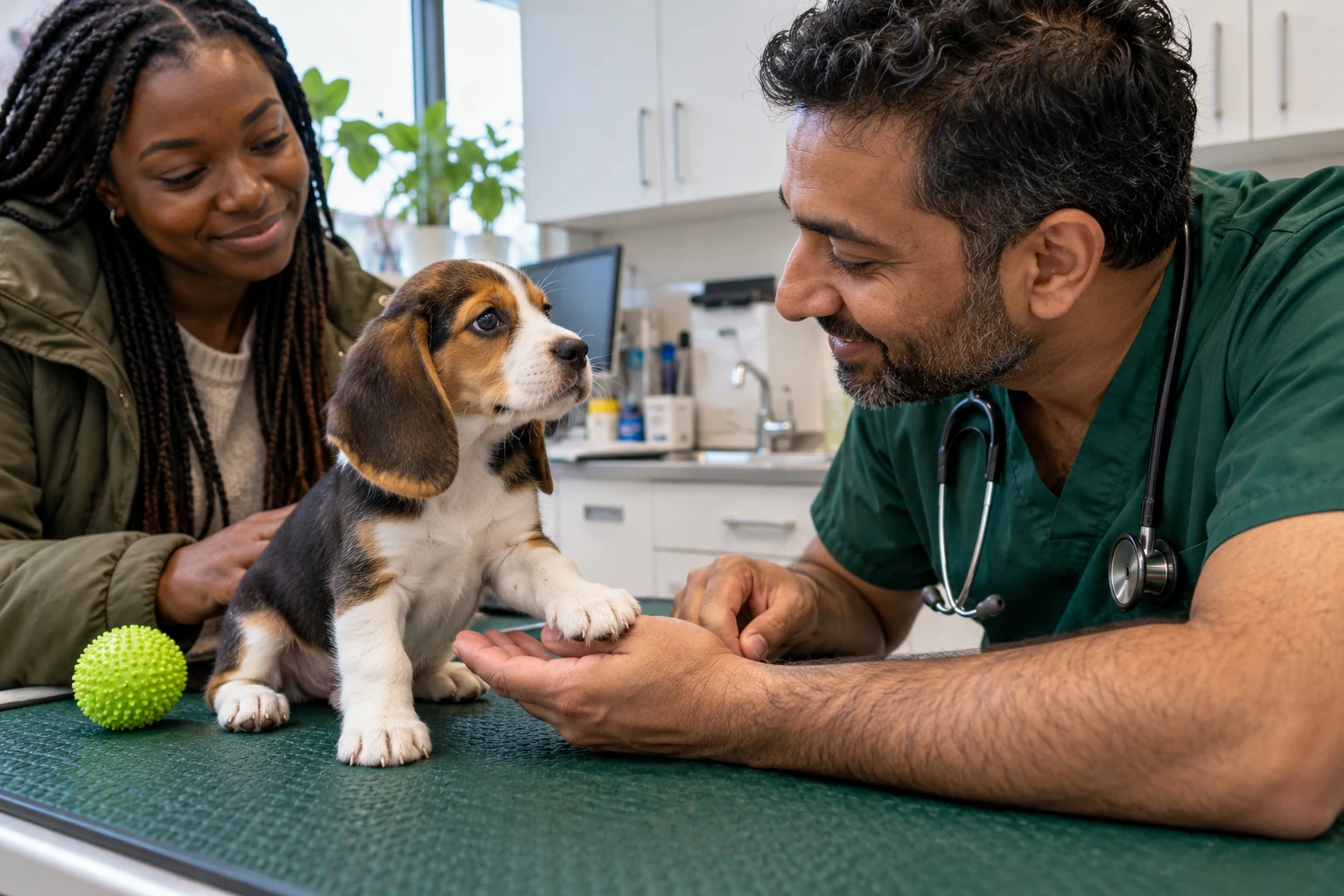
A vet greeting a Beagle puppy on the consulting table at its first visit

WHAT AN INSURER LOOKS AT

MEDICAL HISTORY CAN START BEFORE INSURANCE DOES

A puppy does not need to have made an insurance claim for a health issue to matter to a new insurer. Claims history and veterinary history are different things, and it is the second one that affects what a policy will cover.

New policies generally exclude illnesses or injuries that existed, or showed signs, before cover began. That can include symptoms noted by a vet, advice given, or investigations carried out, whether or not anything was formally diagnosed.

Definitions differ between insurers, and the market is not uniform. Some products will reconsider particular past conditions after a defined period with no symptoms, treatment, medication or veterinary advice. Others will not.

The Financial Ombudsman Service, when it looks at disputes of this kind, considers the policy wording, the veterinary records, whether a later condition is related to an earlier one, and what the customer knew.


A Border Collie puppy looking at its reflection in a hallway mirror

Medical history matters more than claims history

Answer the insurer's health questions accurately and in full, including anything a breeder, rescue or vet has told you. Take reasonable care not to leave anything out, and check any exclusions applied specifically to your puppy on the quote before you buy.

This is general information, not a personal recommendation.

DOES BREED MATTER?

BREED, AND CONDITIONS PRESENT FROM BIRTH

Breed can be one of the factors insurers use when pricing dog insurance, because claims experience differs between breeds.

Policies also differ in how they treat hereditary and congenital conditions, which are conditions a dog is born with or is predisposed to. Some cover them where no signs had appeared before the policy started. Some exclude them. Definitions of what counts vary between insurers.

Do not assume a condition will be covered simply because it had not been diagnosed when the policy started. Check the wording.

If your puppy belongs to a breed with known health considerations, check

  • Whether hereditary and congenital conditions are covered at all
  • The insurer's definition of a pre-existing condition
  • Any exclusions applied specifically to your puppy
  • Condition-specific or treatment-specific limits
  • The excess

WHAT MOVES A QUOTE

WHAT CAN AFFECT WHAT YOU PAY

There is no standard puppy insurance price. Insurers use different rating approaches and weight these factors differently.

Breed

Claims experience differs between breeds, and pricing reflects that.

Age

Age can affect pricing, and premiums may increase as a dog gets older. That does not mean every policy rises by a set amount each year.

Where you live

Veterinary charges vary geographically, and location can influence premiums.

The policy

The cover type, the level of cover and the vet fee limit all affect the quote.

The excess

Different excess structures change what you contribute towards a claim, and can affect the quote depending on the product.

Wider costs

Claims costs and the cost of veterinary treatment across the market can also influence premiums.

Compare the premium alongside the cover type, the vet fee limit, the excess and the exclusions.

A white Samoyed puppy asleep on its back in a dog bed

GET READY

WHAT TO HAVE READY

What you are asked for varies between insurers, but this covers most of it.

  • Your puppy's name, date of birth or age, and breed
  • Whether they are male or female, and whether they have been neutered
  • Your postcode
  • Purchase, adoption or rehoming details where relevant
  • Microchip details
  • Any veterinary advice, symptoms, illness or injury so far, including anything a breeder or rescue told you
  • Details of any temporary or current cover, and when it ends
  • When you want cover to begin

Check the microchip

All dogs in the UK must be microchipped and registered on a compliant database by eight weeks old. If you have just brought your puppy home, check the microchip paperwork and make sure the registered details are yours and are up to date.

This is a legal requirement rather than an insurance one, and microchipping itself is routine care, so it commonly sits outside standard insurance cover. Insurers do often ask about it.

Answer every question accurately and in full, and take reasonable care not to leave anything out. Inaccurate or incomplete information can affect how an insurer handles the policy or a future claim, depending on the circumstances.

COMMON QUESTIONS

WHAT NEW PUPPY OWNERS ASK

Minimum entry ages vary between insurers and products. Some start from a few weeks old, others later. Check the eligibility rules for the policy you are considering rather than assuming a standard age applies.

This is general information, not a personal recommendation.

About this guide

This guide explains how puppy insurance works across the UK market. Insurer terms, entry ages and waiting periods change, so always check the current policy wording, the Insurance Product Information Document and your quote before buying.

Last reviewed 13 August 2026. Sources: Association of British Insurers, Financial Conduct Authority, Financial Ombudsman Service, GOV.UK.

Compare on the cover, then on the price

Compare the cover type, the vet fee limit, the excess, the exclusions and the price side by side.

When our quote service launches, it will compare policies from the providers on our panel. No comparison service covers the whole market.

Dog insurance

The wider picture for insuring a dog.

Types of pet insurance

Lifetime, maximum benefit, time limited and accident only.

Pre-existing conditions

Symptoms, medical history and exclusions.

Vet fee limits and excesses

The numbers behind a claim.