Recall
Begin indoors with a distinctive cue, reward every response generously and progress through fenced spaces to a long line. Do not repeatedly call when success is improbable.
BASSET HOUND BREED GUIDE
Our quote service is not live yet while we onboard insurers. Book a demo to see how it will work.
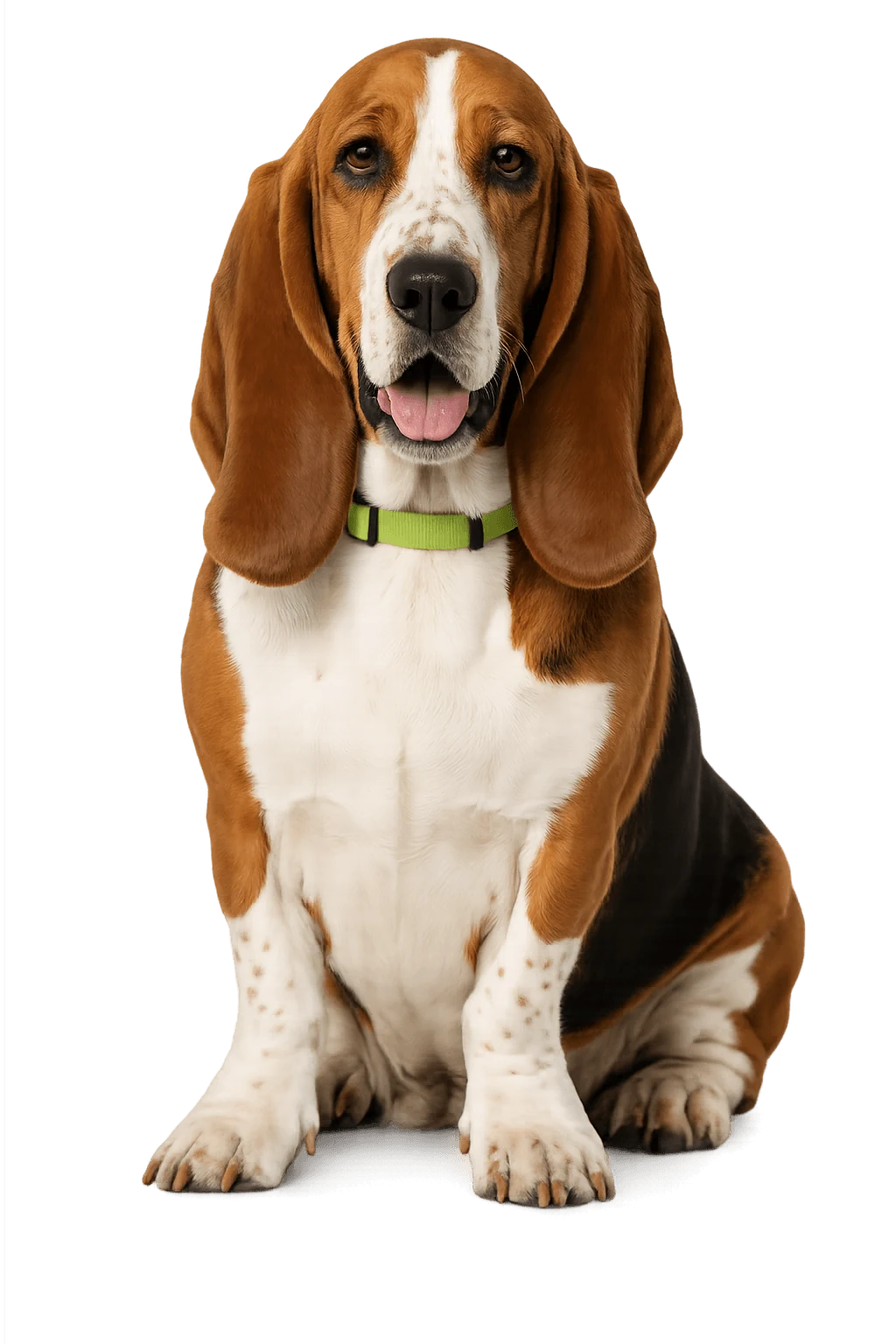
The Basset Hound is a British-developed scent hound bred to follow game slowly enough for hunters on foot. That history explains the short limbs, substantial body, powerful nose, persistent tracking and deep voice. Living well with one is less about long runs and more about scent-driven recall, ear care, weight control and company. [1] [2] [3]
Hound group scent hound
A Basset is low to the ground but can weigh as much as many taller medium to large dogs, which matters for lifting, car access and stairs. [4] [5]
Royal Kennel Club and FCI
The American Kennel Club standard instead specifies not over 14 in (35.6 cm), with over 15 in a disqualification. [2] [3] [4]
Indicative, not a standard requirement
None of the conformation standards prescribes a weight. This range comes from general American Kennel Club breed information and should not be read as a conformation requirement. Body-condition assessment is more meaningful than a single number. [4] [5]
Median, 95% CI 12.2 to 12.7 years
A 2024 UK survival analysis of 584,734 dogs included 2,896 Basset Hounds, of which 883 were recorded dead. An older owner-reported UK breed survey produced a median of around 11.3 years, but sampling and method differ, so the two are not a trend. [6] [7]
Royal Kennel Club broad guide for the breed. Quality matters: a slow, scent-rich walk may satisfy more than the same distance at speed. [1] [2]
The short coat is straightforward. The labour-intensive areas are ears, skin folds, nails and teeth. [1] [2]
Royal Kennel Club breed information. Expect hair, drool, a characteristic hound odour and transferred mud. [1]
These are broad breed characteristics drawn from official breed material and published research. Breeding, early socialisation, learning history, environment, age, health and individual personality all affect the dog you actually live with. [2] [3] [4]
ORIGINS AND BREED STANDARDS
The word basset comes from the French idea of low stature, and several low-legged French hound strains contributed to the breed's ancestry. Hounds from Artois and Normandy were imported into Britain in the nineteenth century, especially from the 1860s, and Sir Everett Millais became influential in the 1870s. Beagle and Bloodhound influence was introduced afterwards, the Basset Hound Club was founded in Britain in 1884, and Queen Alexandra was associated with the breed's early popularity. [1] [2]
The breed's modern identity is British rather than simply French. The FCI lists Great Britain as the country of origin and states that, although the dogs were reputedly bred by French monks, the modern breed was developed in Britain. Long ears and loose skin were traditionally valued as functional scent-hound features, but the present Royal Kennel Club standard emphasises moderation and requires enough ground clearance for free movement. [2] [3]
The three principal standards are broadly consistent. The Royal Kennel Club and FCI specify 33 to 38 cm at the withers. The American Kennel Club specifies not over 14 in, or 35.6 cm, with height over 15 in disqualifying. None prescribes a weight. Temperament language converges on an affectionate, mild or placid, tenacious hound that should be neither aggressive nor timid. [2] [3] [4]
Standards are descriptive breeding ideals, not guarantees of an individual dog's behaviour or health. Temperament is also shaped by parent selection, prenatal and early-life conditions, socialisation, learning history, health, pain and the owner's management. [2] [3] [4]
Practical size interpretation: a Basset is low but not small. Plan for a supportive harness, a low-entry vehicle or ramp, a large enough bed and the ability to handle a dog of roughly 18 to 29 kg during illness or reduced mobility. [4] [5]
TEMPERAMENT AND BEHAVIOUR
The standards' description of a placid and affectionate dog should be read alongside the working description of tenacity, pack instinct and scent-hunting persistence. A Basset may understand a cue perfectly and still continue following an odour, because selective breeding made sustained scent pursuit highly rewarding. [2] [3] [8]
That is independence rather than low intelligence, and it is why repetition and correction often produce poorer results than structured reinforcement and careful management. [2] [8]
Bassets commonly form strong social attachments. The US breed club advises breeders to consider carefully any home where a puppy would be left alone for excessive periods. Independence outdoors does not imply emotional indifference indoors: gradual alone-time training is needed, and day care, a walker or a trusted carer may be necessary for long working days. [8]
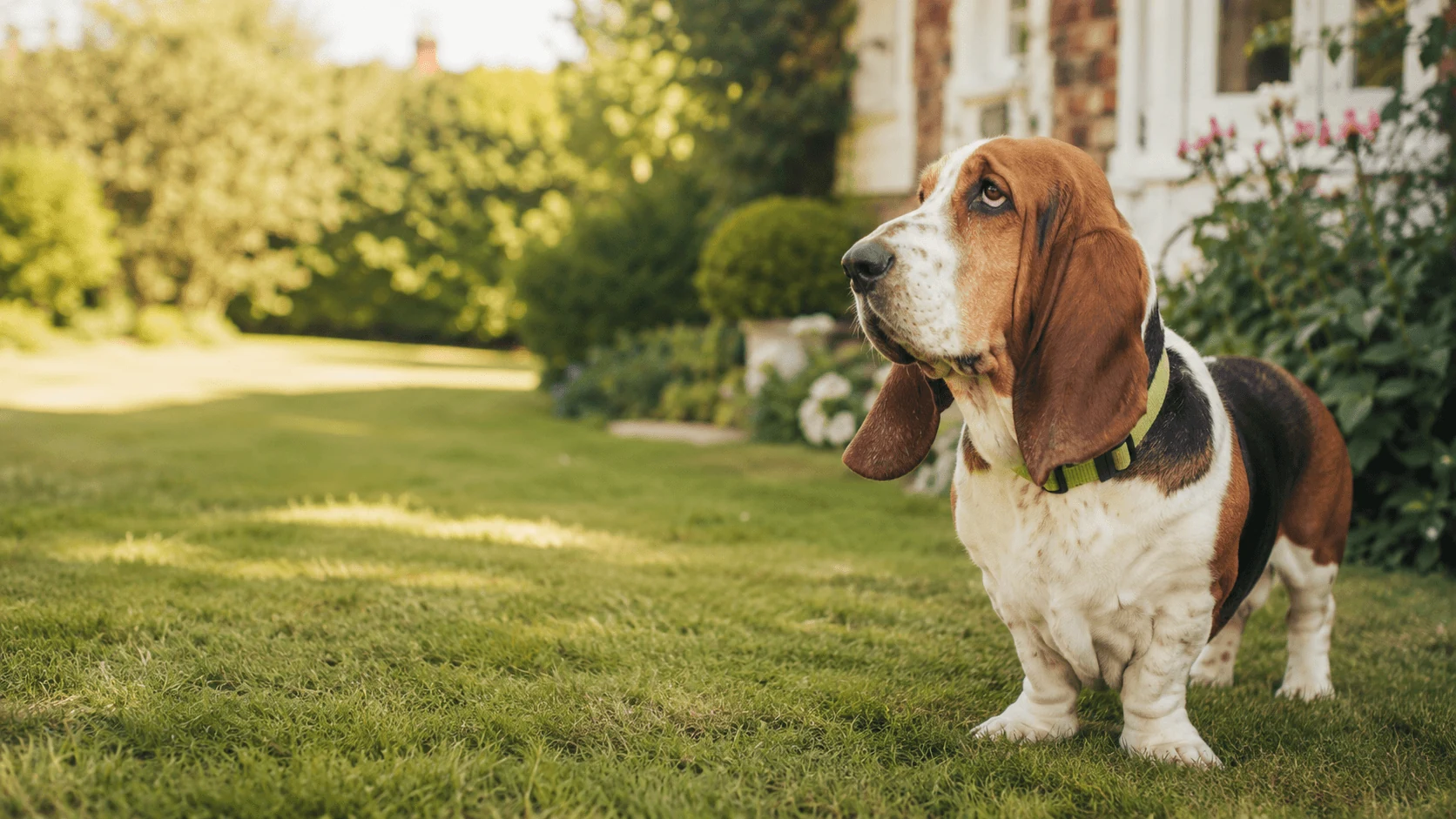
Breed descriptions establish tendencies, not individual prediction. No breed standard or study can determine how a particular puppy will behave. [2] [8]
FAMILY LIFE AND OTHER ANIMALS
Well-socialised Bassets are often sociable with people and dogs and may live successfully with considerate children. The dense body, heavy front and long back make rough handling, climbing by children and uncontrolled play with much larger dogs unsafe. Every dog should have a quiet resting area, and all interactions between children and dogs need active adult supervision rather than reliance on a breed label. [8]
Pack-hound ancestry often favours social tolerance, but compatibility with cats and other dogs depends on early exposure and individual history. Small mammals and wildlife may trigger tracking or chase behaviour. Introduce animals gradually, manage food and resting resources at first, and do not assume the dog is safe with rabbits, poultry or other small animals simply because it is calm indoors. [2] [8]
The breed suits owners who enjoy a socially oriented, humorous but independently minded dog, who can tolerate shedding, drool, odour and a resonant voice, who will use reward-based training and environmental management, and who can maintain a lean body condition throughout life. It is a poorer match for an avid runner, a household needing immediate obedience and reliable open-country recall, or a home where the dog would routinely be left alone for long working days. [8] [9]
EXERCISE AND ENRICHMENT
At a glance
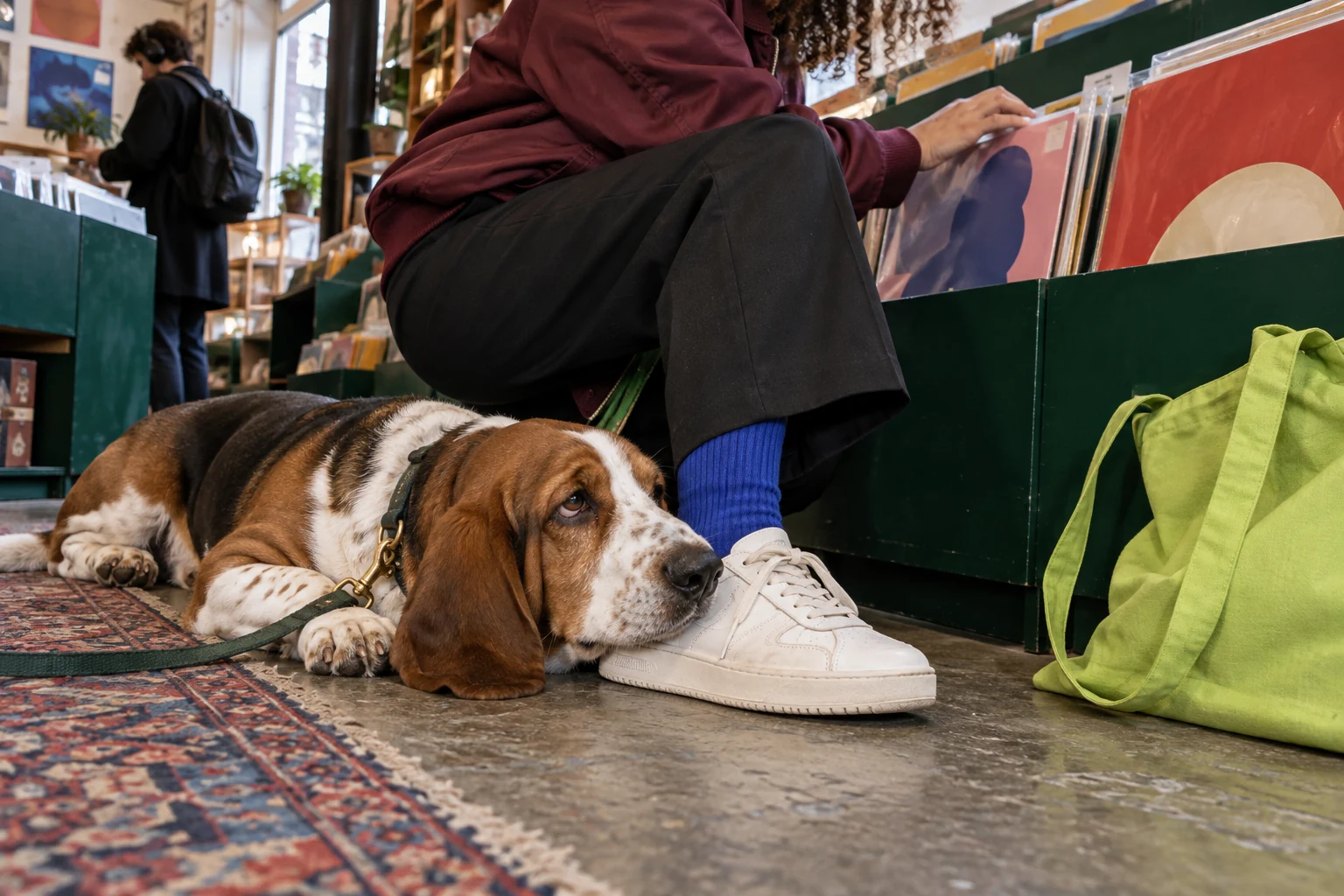
The Royal Kennel Club gives a broad guide of up to one hour a day for the breed. A healthy adult commonly does well with two moderate walks plus short toilet outings, but quality matters. Fitness, weather, terrain, age, body condition and any orthopaedic or cardiac disease should determine the actual amount. [1] [2]
A realistic adult day might include a 25 to 35 minute morning sniff walk, several brief training or food-search sessions, and a 25 to 35 minute evening walk. Suitable activities include tracking, mantrailing, scent work, structured food trails, low-impact rally exercises and controlled woodland exploration. The breed club also supports field trials, tracking, scent work and obedience, which shows a sound Basset need not be restricted to sedentary companionship. [8]
Puppies need frequent short exploration and play rather than forced distance, jogging, repetitive ball chasing or repeated stair and furniture jumping. Senior dogs usually benefit from continued daily movement in shorter sessions, with non-slip flooring, ramps, warm resting areas and veterinary pain assessment when pace, posture or willingness changes.
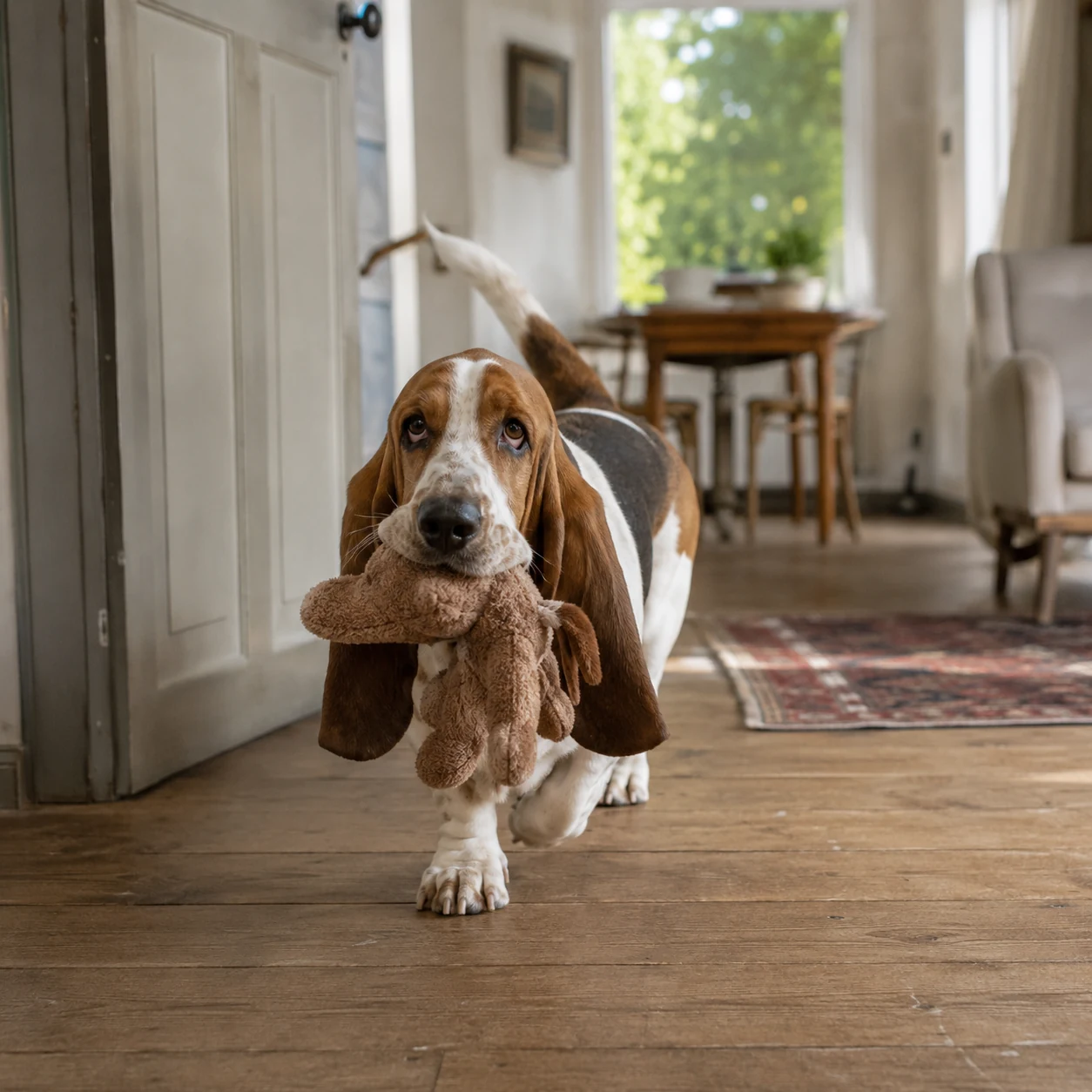
The puppy and senior recommendations above are conservative extrapolations from the breed's structure and the disc-disease evidence. Controlled trials establishing an exact safe exercise dose for Basset puppies do not exist. [12]
TRAINING AND MANAGEMENT
The most effective plan makes desirable choices more rewarding while preventing rehearsal of roaming. Secure areas and long lines are usually safer than relying on conventional off-lead obedience near roads, livestock or wildlife. [8] [9]
Reward-based methods are preferable on both welfare and efficacy grounds. AVSAB and BSAVA recommend reward-based training and advise against electronic collars, prong collars, choke chains, physical corrections and other aversive techniques. A controlled observational study of 92 companion dogs found more stress behaviour, higher post-training cortisol and more pessimistic responses among dogs trained with substantial use of aversives. [9] [10] [11]
When choosing a trainer or behaviourist, look for transparent qualifications, reward-based methods, willingness to work with a long line and scent reinforcement, and referral to a veterinary professional where pain, anxiety or sudden behavioural change may be involved. Online claims that a Basset is dominant, wilfully disobedient or in need of stronger corrections are inconsistent with modern veterinary behaviour guidance. [9] [10]
Begin indoors with a distinctive cue, reward every response generously and progress through fenced spaces to a long line. Do not repeatedly call when success is improbable.
Mark and reward voluntary head turns, check-ins and movement back towards you. Reinforce before the dog becomes fully absorbed rather than after.
Use sniffing as the reward. A few steps of loose-lead walking or a check-in earns permission to investigate a scent patch.
Prefer secure fields or a long line on a well-fitted harness. Avoid retractable leads near roads and never attach a long line to the neck.
Use part of the measured daily ration for training, supplemented by very small high-value rewards where needed.
Identify triggers, reinforce quiet pauses and teach a settle away from windows and doors. Shouting usually adds arousal rather than resolving it.
Condition ear handling, eye inspection, nail touching, tooth brushing and ramp use with brief, rewarded sessions.
Build duration gradually while the dog stays relaxed, vary departure cues and return before any distress escalates.
GROOMING AND HOME LIFE
The coat is short and relatively straightforward, and weekly brushing is generally adequate, but Bassets shed and are not hypoallergenic. A rubber grooming mitt or soft brush removes loose hair. Bathing should be occasional or when dirty, with thorough drying under the ears, between folds and beneath the body. Professional clipping is unnecessary. [1] [2]
The labour-intensive areas are the ears, skin, nails and teeth. Inspect the ear openings and skin folds weekly, clean only according to veterinary advice, dry the dog after wet walks, and check low-slung areas for abrasions, grass seeds or dermatitis. Nails may need frequent trimming, because a long nail changes foot placement and can compound limb stress. Daily tooth brushing is the most useful home dental measure, with veterinary assessment guiding professional cleaning. [13] [14]
Drool, a characteristic hound odour, mud transferred by the low chest and ears, and hair on furniture are normal practical considerations. Homes with many steep stairs are not automatically unsuitable, but repeated unsupervised use is undesirable, particularly for puppies, overweight dogs and dogs with spinal or joint disease. Baby gates, ramps, non-slip surfaces and keeping essential resources on one floor reduce avoidable loading. [8] [12]
HEALTH AND SCREENING
Many Basset Hounds live long, active lives. A breed predisposition identifies a higher probability, a recognised inherited disorder or a screening priority. It does not mean every individual will be affected. Apparent frequency also varies greatly depending on whether the evidence comes from general practice, referral hospitals, screening clinics, genetic-test submissions or owner surveys.
Obesity is particularly undesirable in a long-backed, short-legged dog, because it increases mechanical loading and can worsen mobility and exercise tolerance. The major 2021 UK VetCompass overweight study did not, however, identify the Basset Hound among breeds with significantly increased odds, so weight gain is better described as an important management risk than a proven breed-specific metabolic predisposition. Hypothyroidism should not be assumed from weight gain or lethargy alone. [20]
On lifespan, the 2024 UK survival analysis estimated a median of 12.5 years with a 95% confidence interval of 12.2 to 12.7 years, based on 2,013 Bassets alive at the study cut-off and 883 deaths. An older UK breed-club survey reported a median around 11.3 years and an oldest reported death at about 16.7 years, but it had low and variable breed-level response rates and relied on owner recollection. The older survey attributed roughly 31% of deaths to cancer, 13% to old age, 11% to GDV and 8% to cardiac causes, with the remaining 37% other or unspecified. Those are historical owner-reported proportions rather than current veterinary-record incidence. [6] [7]
For lifelong preventive care, puppies should receive an individualised vaccination and parasite-control plan, developmental and orthopaedic assessment, weight and body-condition monitoring, dental handling and early examination of eyes, ears and skin. Healthy adults should generally have at least annual preventive examinations covering body and muscle condition, mobility, ears, eyes, teeth, heart and abdomen. Senior dogs benefit from examinations at least every six months, with laboratory or imaging screening chosen according to findings, medications, family history and emerging symptoms. [13] [14]
Home monitoring should include monthly weight checks where possible, regular body-condition scoring, weekly ear and skin inspection, frequent tooth brushing, nail trimming before nails alter the gait, and observation for changes in drinking, urination, appetite, sleep, vision, hearing and mobility. [13] [14]
A UK primary-care study found a one-year prevalence of 28.81% and odds around 5.87 times those of crossbreeds, with pendulous ears an independent risk factor. Moisture, inflammation, allergy, infection, foreign material and ear-canal conformation can all interact. Inspect weekly, keep ears dry after bathing, use only vet-recommended cleaners and avoid aggressive cleaning. Odour, redness, pain, discharge, head shaking or loss of balance needs veterinary care. [15]
In 198 screened UK Bassets, 38.4% had moderate or severe pectinate ligament dysplasia. That is a screening abnormality, not a diagnosis, and it does not mean 38.4% develop glaucoma. Primary open-angle glaucoma in the breed is associated with an ADAMTS17 mutation. Specialist eye examination, gonioscopy and DNA testing help stratify risk. Acute eye pain, redness, cloudiness, a dilated pupil or sudden visual difficulty is an emergency. [16] [17]
In a referral study, 68 of 188 Bassets presented to participating neurology services had confirmed thoracolumbar disc extrusion. That 36.2% is a referral-clinic proportion, not general-population incidence. Short-limbed chondrodystrophic structure, disc degeneration, multiple genes and loading all contribute. Keep the dog lean, reduce repeated jumping from furniture and uncontrolled stair descent, and use ramps where practical. Sudden weakness, paralysis, severe spinal pain or loss of bladder control needs urgent assessment. [12]
No reliable population prevalence for the breed was identified, but the breed is listed by the BVA among those at risk and elbow screening is part of current UK recommendations. BVA and Royal Kennel Club radiographic grading runs from 0 to 3 from at least 12 months of age, and the scheme recommends breeding from grade-0 dogs. Maintain lean growth, avoid excessive repetitive impact in immature dogs and investigate forelimb lameness or stiffness. [17] [18]
Population prevalence is uncertain, but the condition is established enough for official UK and US DNA-testing recommendations. It is an autosomal-recessive mutation causing abnormal glycogen accumulation, with signs commonly beginning around five to seven years and possibly including stimulus-sensitive jerks and progressive seizures. Test breeding dogs before mating and do not mate carrier to carrier. [17] [19]
In the US breed club's June 2022 testing data, 4% of 545 tested dogs were carriers and none was affected. That is a submitted-test sample, not a random prevalence study. It is an autosomal-recessive platelet-function defect, so affected dogs can bleed excessively despite a normal platelet count. Tell a vet of known status before surgery, and investigate unexplained bruising, nosebleeds, gum bleeding or prolonged bleeding promptly. [19]
In US breed club data to June 2022, 532 Bassets had been tested: 483 clear, 37 carriers and 12 affected. The sample is selected and does not estimate worldwide prevalence. It is an autosomal-recessive lysosomal storage disorder, and severely affected puppies may show skeletal, neurological and ocular abnormalities from around six to eight weeks. MPS1 is not currently in the Royal Kennel Club's principal Basset testing recommendations, so line history and country of origin matter. [17] [19]
In the historical UK breed mortality survey, GDV accounted for about 11% of reported Basset deaths. That estimate is old, owner-reported and based on only 142 deaths. There is no genetic screening test. Non-productive retching, abdominal enlargement, restlessness, collapse or pale gums requires immediate emergency care. No feeding schedule can guarantee prevention, and owners of dogs with a strong family history should discuss individual risk and preventive gastropexy with their vet. [7]
Percentages drawn from referral populations, screening cohorts, genetic-test submissions or voluntary owner surveys are not the probability for an average puppy. This guide is general information and is not a diagnosis or a substitute for veterinary advice. [12] [15] [16] [19]
Our quote service is not live yet while we onboard insurers. Book a demo to see how it will work.
Book a demoPOLICY TERMS THAT MATTER
A breed predisposition does not mean your dog will develop a condition, and it does not tell you whether treatment would be covered. Cover depends on the individual policy, its exclusions and limits, when signs or symptoms first appeared, and your pet's medical history.
These are the terms worth reading closely if you are arranging or comparing cover for a Basset Hound. Wording varies between providers, so check the policy documents rather than assuming any of them applies.
Anything already recorded in your pet's veterinary history may be relevant to an insurer's assessment. Definitions differ between providers, so read this one first.
Inherited and congenital conditions are never automatically covered. Check whether they are included, excluded or limited.
Long term conditions are managed year after year, so check whether treatment continues at renewal and how limits apply across policy years.
The overall limit, and whether it resets each year, usually matters more for a large claim than any single headline feature.
Specialist referral, scans and investigations are sometimes capped separately from treatment.
Where a second problem is treated as related to the first, it draws on the same limit rather than starting fresh.
Some policies add a percentage contribution as a pet gets older. The age threshold and how the contribution applies vary, so check the policy terms.
This is general information, not a personal recommendation.
FEEDING AND WEIGHT
Feed a nutritionally complete diet appropriate to life stage and health status, adjusting portions to body condition rather than relying only on the packet's generic allowance. WSAVA and BSAVA support the nine-point body-condition scale. At an ideal score of around 4 to 5 out of 9, ribs should be readily palpable with limited fat cover, with a visible waist and abdominal tuck appropriate to the dog's construction. [14] [20]
Measure food rather than free-feeding, account for chews and training rewards, and reassess portions after neutering, reduced exercise or ageing. A practical method is to reserve part of each meal for recall and scent games. Rapid unexplained weight change, persistent hunger accompanied by other signs, muscle loss or difficulty swallowing needs veterinary assessment rather than repeated diet changes or unprescribed supplements. [13] [14]
Because GDV appears in the historical mortality data, divide large daily allowances into sensible meals and avoid letting a dog gulp a very large volume at once. Evidence for many commonly repeated rules about meal timing, bowl height and exercise is inconsistent, no feeding method removes GDV risk, and signs of bloat should never be managed at home. [7]
BUYING OR ADOPTING
An ethical breeding programme should aim for a dog that can move freely, exercise without structural interference, breathe normally, keep adequate ground clearance and remain free from excessive ears, skin or weight. Both the Royal Kennel Club and FCI standards explicitly reject harmful exaggeration, and the Royal Kennel Club currently places the breed in Breed Watch Category 3, so judges and breeders are asked to monitor visible conditions or exaggerations capable of affecting health and welfare. [1] [2] [3]
In the UK, current Royal Kennel Club recommendations centre on clinical eye examination and gonioscopy, DNA tests for Lafora disease and POAG-3, and BVA and Royal Kennel Club elbow grading. In the US, the breed club strongly recommends DNA testing for thrombopathia, primary open-angle glaucoma, MPS1 and Lafora disease. Panels differ by country, which may reflect line history, test uptake and national priorities rather than a biological boundary, so imported breeding animals should be assessed against both countries' requirements. [17] [18] [19]
A responsible breeder should provide original, independently verifiable results for both parents rather than saying that a line is vet checked or clear by pedigree without documentation. Verify permanent identification, test dates and the exact variant tested through the relevant registry. A CHIC number means the parent club's required tests were completed and published, not that every result was normal. [17] [19]
For recessive disorders, removing every carrier can unnecessarily reduce genetic diversity. The US breed club policy permits a healthy carrier to be bred to a tested-clear dog, with testing and disclosure for the offspring, while excluding affected dogs and carrier-to-carrier matings. Breeders should also examine the planned litter's coefficient of inbreeding, avoid repeatedly using fashionable sires and review health and longevity across the wider pedigree. [19]
Breed rescue may offer adults whose temperament, sociability and home behaviour have already been observed in foster care. A reputable organisation performs veterinary assessment, discloses known medical and behavioural information, screens adopters, arranges household and resident-dog introductions, uses a written contract and accepts the dog back if the placement fails. Same-day handovers or transport without meaningful assessment are warning signs. Before adopting, ask about ear, eye, dental and mobility findings, current weight and diet, medication and diagnostic records, tolerance of children and other animals, behaviour when alone, and the post-adoption and return arrangements. [8] [19]
Testing reduces risk, it does not guarantee a healthy puppy. Even grade-0 elbow parents can produce affected offspring, and gonioscopy grades drainage-angle anatomy rather than predicting whether or when glaucoma will occur. [16] [17] [18]
COMMON QUESTIONS
EDITORIAL STANDARDS
This guide uses current official breed material, UK welfare and veterinary guidance and original or openly accessible research. Breed standards describe an ideal, health-test recommendations are not prevalence estimates, and observational research establishes association rather than individual prediction. Health guidance is reviewed when material official recommendations or evidence change.
This guide provides general information about Basset Hounds. Individual dogs vary, and the health information is not a diagnosis or a substitute for veterinary advice.
KEEP READING
Researching more than one breed? These guides follow the same format, so you can compare temperament, health and day to day needs side by side.
WHEN YOU ARE READY
Our quote service is not live yet while we onboard insurers. Book a demo to see how it will work.