Yeti Compare

COCKAPOO BREED GUIDE

IS A COCKAPOO RIGHT FOR YOUR HOUSEHOLD?

Our quote service is not live yet while we onboard insurers. Book a demo to see how it will work.

The Cockapoo is an intentionally bred cross between a Cocker Spaniel and a Poodle. It is not a standardised pedigree breed, has no Royal Kennel Club breed standard, and varies substantially in adult size, coat, shedding, temperament and health according to the exact parents, Poodle variety, Cocker line and breeding generation. [1] [2] [3]

For most UK households a Cockapoo is best approached as a small-to-medium, active, people-oriented gundog and water-retriever cross needing about an hour of varied adult exercise, daily mental activity and substantially more coat care than its low-shedding reputation implies. [4] [5] [3] [6]

A cream wavy coated Cockapoo sitting square on and facing the camera

THE CROSS IN BRIEF

THE COCKAPOO

Typical ranges rather than a breed standard. There is no Royal Kennel Club Cockapoo standard, so these are general expectations to check against the individual dog and its parents.

Recognition
Crossbreed

No Royal Kennel Club standard

No Royal Kennel Club Cockapoo breed standard or controlled size varieties exist. [2] [7]

Typical size
Small to medium

Depends on the exact parents

No authoritative Cockapoo height or weight range exists. Parent size and mature relatives predict adult size better than marketing labels. [4] [8] [7] [3]

ToyGiant
Typical lifespan
12+ years

A typical figure, not a measured median

A robust Cockapoo-specific UK life-table estimate is unavailable. Dogs Trust lists approximately 12+ years. [4] [9]

Coat
Highly variable

Can vary within one litter

Shedding and maintenance vary even between littermates. [10]

Grooming
Brushing or combing at least several times weekly, often daily for long, wavy or curly coats

Clipping commonly every four to eight weeks. [11] [12]

LowHigh
Adult exercise
About 60 minutes

Individual needs vary

A starting point based on the parent breeds rather than a Cockapoo-specific figure. [13] [14] [15]

LowHigh
Training
Generally responsive to rewards, but not automatically easy

Recall, calm settling, grooming cooperation, impulse control and gradual alone-time training are the priorities. [16] [17] [18]

ChallengingEasy
Time alone
Not a good default choice for long, routine absences

Dogs Trust recommends building alone time gradually and generally avoiding periods longer than four hours. [17] [19]

Lower toleranceHigher tolerance
Family fit
Often viable with considerate children and supervised interactions

Individual temperament and socialisation matter more than the crossbreed label. [20] [4]

Parentage

Cocker parent
English show, English working or American Cocker Spaniel
Poodle parent
Most often Toy or Miniature, sometimes Standard
Generation labels
F1, F1b, F2 and later terms are descriptive, not regulated

Main health priorities

Most reported themes
Ear disease, itchy skin, anal-sac disorders, gastrointestinal problems, ticks
Inherited risks
Eye, neurological and orthopaedic risks depend on the exact ancestry

These are typical ranges rather than a breed standard. Labels such as toy, miniature, maxi, F1 and F1b are descriptive breeding terms rather than officially recognised Cockapoo varieties. [2] [3] [7]

ORIGINS, TYPES AND VARIATION

WHERE THE COCKAPOO COMES FROM

The Cocker Spaniel was developed as a compact gundog used to find and flush game, particularly woodcock. The UK breed became separately recognised in 1893, and its standard describes an energetic, affectionate, exuberant dog with strong scenting and sporting attributes. The Poodle originated in continental Europe, associated particularly with Germany, as a water retriever used by duck hunters. The Royal Kennel Club recognises Toy, Miniature and Standard Poodles, differentiated by size. [13] [8] [3]

Intentional Cocker and Poodle crosses are documented in the United States from approximately the 1950s or 1960s. The precise first Cockapoo litter and breeder are not reliably established in primary historical records. The Cockapoo Club of Great Britain reports that Cockapoos were known in the United States by about 1950 and notes a dictionary reference from 1960. That should be treated as an approximate historical account rather than a definitive origin event. [2]

An F1 Cockapoo has one Cocker Spaniel parent and one Poodle parent. An F1b is produced by breeding an F1 Cockapoo back to a Poodle or, less commonly, to a Cocker Spaniel. An F2 generally describes a mating involving two first-generation Cockapoos, while later generations and b suffixes describe subsequent Cockapoo-to-Cockapoo or backcross matings. Usage is not governed by the Royal Kennel Club, and individual clubs or breeders may apply later-generation labels differently. [2] [21]

An F1b backcross to a Poodle increases the expected average proportion of Poodle ancestry, but it does not guarantee a particular coat, shedding level, allergy response, personality or health outcome. Genes are inherited in combinations rather than as precisely blended percentages of visible traits, and littermates can differ markedly. The 2024 Royal Veterinary College results provide no basis for assuming that additional Poodle ancestry automatically produces superior health. [10] [22] [23]

There is no controlled Cockapoo size taxonomy. Teacup, toy, miniature, medium, maxi and standard are commercial or club conventions rather than Royal Kennel Club standards. Teacup is especially uninformative because it is not a recognised Poodle variety: the recognised Poodle categories are Toy, Miniature and Standard. [2] [24] [3] [25]

Because no representative UK dataset defines Cockapoo adult weight by parental combination, exact puppy-advertisement ranges should be treated as estimates. Ask for the measured height and weight of both parents and, ideally, several mature full or half-siblings. The Cocker parent's line and the exact Poodle variety are more meaningful than labels such as mini or maxi. [2] [8] [24]

What actually varies

  • Adult size, which follows the exact parents rather than the generation label
  • Coat pattern: straight, loose-wavy or ringlet, or tightly curled
  • Shedding, which is not predictable enough for allergy decisions
  • Grooming burden, which follows the coat rather than the body size
  • Working-Cocker ancestry, which can bring more intensity, scent interest and retrieval drive

Coat colour

  • Black, cream, red, apricot, chocolate, tan, white, parti-colour and roan all occur
  • Colour should not be prioritised over temperament, conformation and health testing
  • Marketing a colour as rare says nothing reliable about health or quality

Working versus show Cocker ancestry is not a reliable behavioural diagnosis for an individual puppy. [2] [10] [8] [17] [26]

HEALTH AND LONGEVITY

WHAT THE UK EVIDENCE ACTUALLY SHOWS

The best available UK health research does not support a general claim that Cockapoos are healthier than their parent breeds. In a 2024 survey of 9,402 UK dogs, 86.6% of comparisons across 57 disorders showed no significant difference between Cockapoos, Labradoodles and Cavapoos and their respective parent breeds. Designer crosses had a higher risk in 7.0% of comparisons and a lower risk in 6.4%. Cockapoos were particularly notable for ear infections, itchy skin and gastrointestinal problems. [22] [23]

A practical lifespan expectation is around 12 years or more, but this is not a Cockapoo-specific median derived from UK veterinary records. Dogs Trust lists approximately 12+ years, while published UK life tables have generally grouped crossbreeds together rather than estimating Cockapoos separately. A range such as 12 to 15 years may be useful for long-term planning but should not be presented as a measured Cockapoo average. [4] [9]

Many Cockapoos live long, healthy lives. A predisposition or elevated relative risk does not mean an individual dog will develop the condition. Conversely, crossbreeding does not eliminate diseases present in either ancestral breed. [22] [23]

The conditions below are a list of health priorities, not a ranking from most to least common. Prevalence figures appear only where Cockapoo-specific evidence exists, and those figures come from different study periods, populations and methodologies, so they should not be ranked directly against one another. [27] [28] [29]

Otitis externa and recurrent ear disease

Annual Cockapoo prevalence approximately 12.97% in a UK primary-care study, against 7.30% in dogs overall. Owners may notice head shaking, scratching, smell, redness, discharge, pain or reluctance to have ears handled. Examine ears at least weekly, dry the pinnae and canal entrances after swimming or bathing, and investigate allergy or skin disease in recurrent cases. Recurrent cases need the underlying cause treated rather than repeated empirical cleaning. [27] [22]

Allergic or itchy skin disease

Cockapoos had a higher likelihood of itchy skin than both parent breeds in the 2024 survey, though a robust breed-specific absolute prevalence was not reported. Paw licking, rubbing, recurrent ear trouble, red skin, hair loss, secondary infection or seasonal itching are the usual signs. Choose breeders who disclose skin and ear histories across both family lines, maintain appropriate parasite control, and seek early assessment rather than repeatedly changing food without a diagnosis. [22] [23]

Anal-sac disorders

Cockapoo annual prevalence approximately 8.47% in the underlying study, with 2.59 times the odds of diagnosis compared with crossbred dogs, from 2,372 cases among 104,212 UK dogs. Scooting, licking beneath the tail, discomfort sitting, swelling, smell, straining or discharge are typical. Maintain healthy body condition and stool quality and investigate recurrent diarrhoea, constipation or skin disease. Routine expression in an asymptomatic dog is not necessarily beneficial. [28] [30]

Gastrointestinal upset and dietary indiscretion

Designer crosses had more dietary indiscretion, vomiting and diarrhoea than Poodles in the 2024 survey, and a separate UK acute-diarrhoea study reported increased odds for Cockapoos, though a reliable absolute annual prevalence was not established. Teach leave and drop, secure bins, food, medicines and foreign objects, change diets gradually and avoid excessive treats. Persistent vomiting, blood, pain, lethargy or repeated diarrhoea needs veterinary advice. [22] [31]

Tick infestation and tick-borne exposure

Five-year Cockapoo frequency 4.79%, compared with 2.03% in dogs overall in the same UK study, placing Cockapoos among the breeds with the highest recorded frequencies. Check the whole dog after rural, woodland or long-grass walks, including ears, face, toes, armpits and groin, and use a vet-advised risk-based parasite plan. Remove ticks promptly with an appropriate tool or obtain veterinary help. [29] [32] [33]

Progressive retinal atrophy and inherited eye disease

Cockapoo prevalence is unknown. Both Poodle and Cocker lines can carry inherited eye disorders, and prcd-PRA testing and clinical eye screening feature in official parent-breed recommendations. Poor night vision, bumping into objects, dilated pupils, redness, discharge or pain can be signs, although early inherited disease may show nothing at all. DNA results predict specified variants only and do not replace a clinical eye examination. [13] [14] [3]

Hip dysplasia

No reliable Cockapoo prevalence is available. Official Cocker and all three Poodle-variety guidance includes hip screening as best practice or recommended screening. Stiffness, altered gait, difficulty rising, reluctance to jump or reduced hindlimb muscle can appear, and some affected dogs show few signs when young. BVA and Royal Kennel Club hip scoring of breeding parents, lean growth and avoiding excessive repetitive high-impact puppy exercise are the practical measures. [13] [14] [3] [34]

Patellar luxation

Cockapoos had lower odds than Poodles in the 2024 survey, but the condition still occurs and no Cockapoo absolute prevalence was provided. Intermittent skipping, carrying a hind leg for several strides, lameness or difficulty jumping are the usual signs. Ask about patellar and orthopaedic history in parents and close relatives, and request a veterinary musculoskeletal examination of breeding dogs, especially in small lines. [22]

Familial nephropathy

Absolute Cockapoo prevalence is unknown. It is an inherited kidney disorder recognised in English Cocker lines, for which DNA testing is officially recommended. Increased thirst or urination, poor growth, weight loss, vomiting or lethargy in a young dog are possible signs. DNA-test the relevant English Cocker parent and trace the result through multigeneration ancestry. [13] [35]

Parent-line inherited neurological, skeletal or bleeding disorders

Cockapoo-specific prevalence is generally unavailable. Relevant variants include adult-onset neuropathy and acral mutilation syndrome in Cocker lines, osteochondrodysplasia in Miniature Poodles, rcd4-PRA and von Willebrand disease type 1 in Standard Poodles, and PFK deficiency in some American Cocker lines. Use ancestry-specific DNA testing rather than a generic Cockapoo clear claim, with original laboratory certificates available. [13] [36] [35]

This is general information rather than a diagnosis. Speak to a vet about symptoms or concerns affecting an individual dog. [22] [23]

POLICY TERMS THAT MATTER

WHAT THIS MEANS FOR PET INSURANCE

A breed predisposition does not mean your dog will develop a condition, and it does not tell you whether treatment would be covered. Cover depends on the individual policy, its exclusions and limits, when signs or symptoms first appeared, and your pet's medical history.

These are the terms worth reading closely if you are arranging or comparing cover for a Cockapoo. Wording varies between providers, so check the policy documents rather than assuming any of them applies.

Pre-existing condition wording

Anything already recorded in your pet's veterinary history may be relevant to an insurer's assessment. Definitions differ between providers, so read this one first.

Hereditary and congenital wording

Inherited and congenital conditions are never automatically covered. Check whether they are included, excluded or limited.

Chronic and recurring conditions

Long term conditions are managed year after year, so check whether treatment continues at renewal and how limits apply across policy years.

Veterinary fee limit

The overall limit, and whether it resets each year, usually matters more for a large claim than any single headline feature.

Referral, diagnostics and imaging

Specialist referral, scans and investigations are sometimes capped separately from treatment.

Bilateral and related condition definitions

Where a second problem is treated as related to the first, it draws on the same limit rather than starting fresh.

Excess and percentage contribution

Some policies add a percentage contribution as a pet gets older. The age threshold and how the contribution applies vary, so check the policy terms.

For what hereditary, congenital, pre-existing, related and bilateral actually mean, see our guide to how breed affects pet insurance.

This is general information, not a personal recommendation.

BREEDER TESTING AND PREVENTIVE CARE

TESTING MUST FOLLOW THE EXACT ANCESTRY

A robust breeder-health programme should test both parents according to their exact ancestral breeds and Poodle variety. Depending on the mating, this may include DNA tests for prcd-PRA, rcd4-PRA, familial nephropathy, adult-onset neuropathy, acral mutilation syndrome, osteochondrodysplasia and von Willebrand disease type 1, together with BVA and Royal Kennel Club eye, gonioscopy and hip schemes. Testing reduces specific risks but cannot guarantee a healthy puppy or predict polygenic disease, allergies, behaviour or coat. [37] [14] [3] [34] [35]

For an English Cocker and Toy Poodle mating, the evidence-led minimum should include relevant DNA testing for prcd-PRA on both sides, acral mutilation syndrome, adult-onset neuropathy and familial nephropathy for the Cocker, BVA, Royal Kennel Club and ISDS eye screening for both, gonioscopy where advised for the Cocker, and BVA and Royal Kennel Club hip scoring for both parents. [13] [3]

For an English Cocker and Miniature Poodle mating, add the Miniature Poodle osteochondrodysplasia DNA test. For a Standard Poodle parent, verify the current Standard Poodle requirements, including prcd-PRA, rcd4-PRA and von Willebrand disease type 1, alongside eye and hip screening. For an American Cocker parent, verify prcd-PRA, clinical eye examination, gonioscopy and hip screening, and discuss PFK testing according to the line. [36] [34] [35]

For F1b, F2 and multigeneration Cockapoos, testing must follow all identifiable ancestral lines. Testing only the most recent Poodle or Cockapoo parent may miss a variant carried through an earlier Cocker or a different Poodle variety. Both sire and dam contribute equal genetic material and should be appropriately screened. [37] [21]

A DNA result can show that a dog is clear, a carrier or genetically affected for a particular tested variant. It cannot establish that the dog is free from all inherited disease, cannot assess hip structure or most complex diseases, and cannot predict allergy, ear disease or behaviour. BVA and Royal Kennel Club schemes and clinical examinations therefore remain necessary alongside DNA tests. [38] [37]

Preventive veterinary schedule

  • Before or immediately after acquisition: review the microchip, vaccination record, parasite history, parent-test certificates and any rescue medical or behaviour report. In the UK, dogs must be microchipped and registered by eight weeks, and keeper details kept current. [39]
  • Approximately 6 to 16 weeks: complete the vaccination course according to the product, maternal-antibody risk and practice protocol. UK guidance commonly begins at six to nine weeks with a further dose roughly four weeks later. [40] [41]
  • Puppy visits: monitor growth, body condition, bite, retained teeth, patellae, gait, skin, ears, heart and gastrointestinal health, and establish cooperative handling.
  • Around skeletal maturity: discuss neutering individually. Updated 2026 BVA and BSAVA guidance recommends contextual assessment and generally moving away from early neutering, with maturity commonly around 12 to 24 months. [42] [43]
  • At least annually in healthy adults: full examination plus vaccination and parasite review. Core UK vaccines include distemper, adenovirus or hepatitis, parvovirus and leptospirosis, with kennel-cough vaccination exposure-dependent. [33] [44]
  • Vaccination review: leptospirosis generally requires annual boosting, while distemper, hepatitis and parvovirus are often boosted at longer intervals. [45] [46]
  • Parasite review: use an individual risk assessment based on age, travel, scavenging, hunting, raw feeding, contact with children, rural exposure and previous infestation. [33]
  • Senior stage or chronic disease: increase monitoring as advised, often six-monthly, and consider blood pressure, blood and urine testing, mobility, dental evaluation and weight and muscle condition.
  • Any age: persistent itching, recurrent ear odour, head shaking, repeated diarrhoea, scooting, lameness, altered thirst, visual change, unexplained bleeding, weight loss or behaviour change should not wait for the annual visit. [44] [18]

Daily tooth brushing with dog toothpaste is the preferred home dental routine. Visible tartar, inflamed gums, pain or bad breath warrants veterinary assessment rather than forceful brushing. [47]

GROOMING AND COAT CARE

LOW SHEDDING IS NOT A LOW MAINTENANCE COAT

Cockapoo grooming burden is commonly underestimated because low visible shedding is confused with a low-maintenance coat. In a curly or wavy dog, shed hair can remain trapped and bind with the growing coat, producing tight mats close to the skin. The coat transition around later puppyhood can be particularly difficult as the puppy coat is replaced by adult hair. [11] [10]

A metal comb should reach the skin without snagging after brushing. A coat that looks fluffy on top can still be tightly matted beneath. Severe matting should be clipped professionally rather than pulled apart painfully.

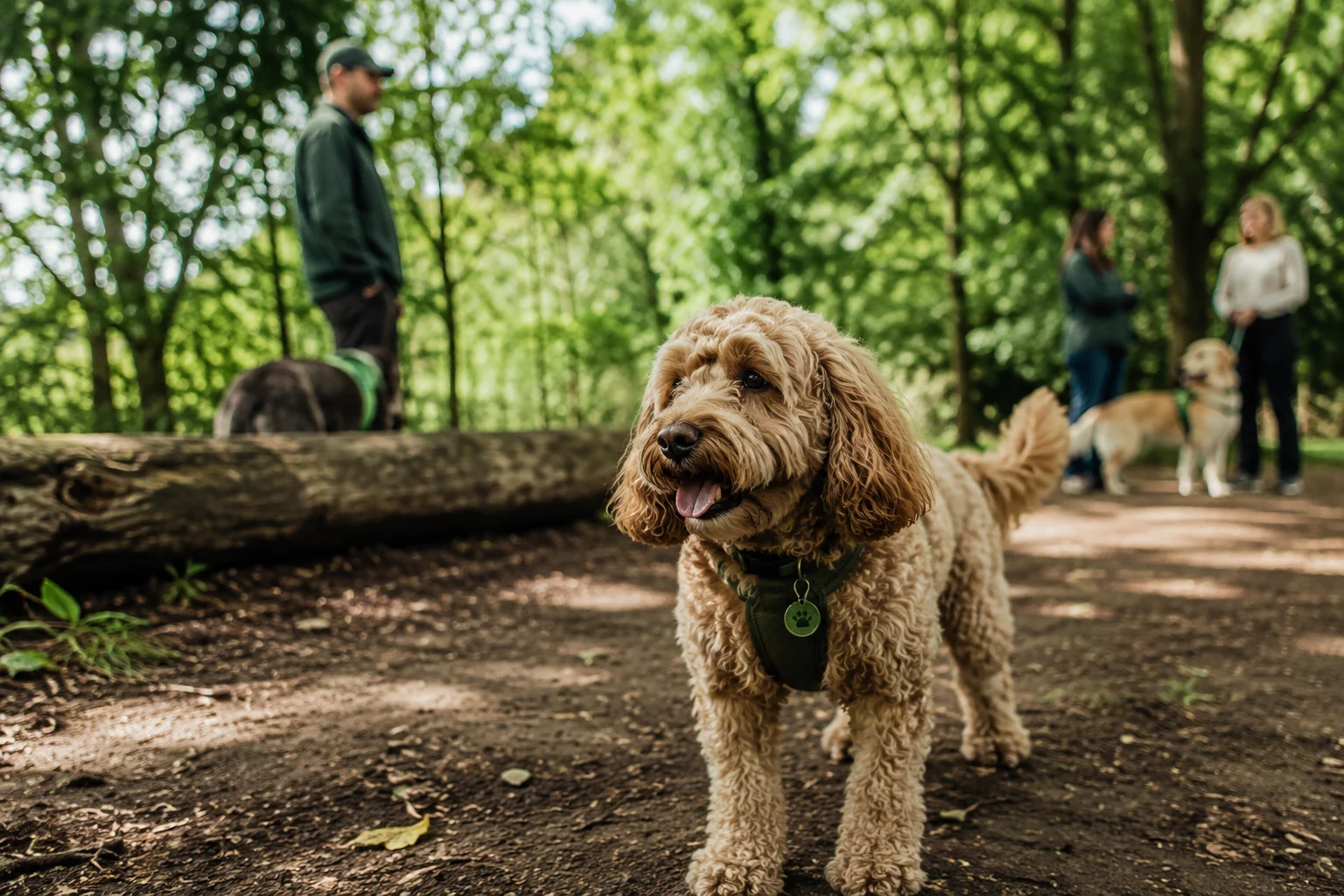
A cream curly coated Cockapoo standing on a woodland path with dog walkers behind

A practical routine for a clipped wavy or curly adult

  • A brief daily check and comb of ears, cheeks, collar and harness areas, armpits, groin, tail base, feet and lower legs
  • A systematic root-to-tip comb several times weekly, daily for long or dense coats
  • Professional grooming commonly every four to eight weeks, with broader welfare guidance giving four to twelve weeks for long or rough coats [12]
  • Weekly ear inspection, plus checks after swimming, heavy rain and bathing
  • Daily tooth brushing, and nail checks every one to two weeks with trimming whenever nails affect stance, grip or comfort [47] [48]
  • Bathing when dirty or as part of the grooming cycle, using a dog-appropriate product and drying the coat fully [49]

Coat type and realistic maintenance

  • Flat or straight coats: more Cocker-like, often more visible shedding, low to moderate maintenance, and some may not need routine clipping
  • Wavy or ringlet coats: frequently low shedding but prone to friction matting, high maintenance and usually clipped
  • Tightly curled coats: little visible shedding with hair trapped in the coat, very high maintenance with daily or near-daily combing
  • Larger bodies carry more coat, so professional grooming time is generally greater

Healthy dogs do not need frequent cosmetic bathing merely to mask odour. Persistent smell may indicate skin or ear disease. Cockapoos are not hypoallergenic, and coat type cannot be guaranteed reliably from the generation label alone. [49] [6] [50]

EXERCISE BY LIFE STAGE

ABOUT AN HOUR A DAY, VARIED RATHER THAN FAST

A healthy adult Cockapoo commonly needs approximately one hour of physical activity daily, often divided between two outings, with additional sniffing, play and short training sessions. This is a starting point based on the parent breeds rather than a Cockapoo-specific figure. High-drive working-Cocker crosses may need more purposeful activity, while smaller, older or medically affected dogs may need less. [13] [14] [15]

For puppies, there is no strong evidence that a universal five minutes per month of age formula precisely prevents joint disease. A safer approach is several short, self-paced periods of walking, exploration and play, allowing rest and avoiding forced running, repeated stair work, prolonged ball chasing, sharp turns, leaping and repetitive jumping while the body is developing. [51]

During adolescence, gradually increase duration and environmental difficulty while preserving calmness. More mileage alone may create a fitter, more aroused dog without teaching self-control. Alternate active walks with sniffing, search games, retrieval to hand, food puzzles and mat-settling.

Senior dogs generally benefit from continuing daily movement in shorter, more frequent sessions. Walking duration, terrain and intensity should be adapted to mobility, heart health, vision, hearing and weather rather than stopped solely because of age.

In warm conditions, move exercise to cooler parts of the day, reduce intensity and prioritise water, shade and airflow. Exercise is a leading trigger for canine heatstroke, and even an ordinary walk can be hazardous during very hot weather. [52] [53]

A sample week for a healthy adult

  • Monday: two walks totalling about 60 minutes, one brisk or exploratory and one slower sniff walk, plus five minutes of recall practice. Full root-to-tip comb, teeth, ears and paws
  • Tuesday: two shorter walks plus a food search, retrieval game or simple scent trail. Quick comb of mat-prone areas and a check under collar and harness
  • Wednesday: varied route with long-line recall and controlled exploration, then a short mat settle. Full comb and brush, and check eyes, ears, skin, anal area and nail length
  • Thursday: lower-intensity sniff-focused day with puzzle feeding and brief training sessions. Quick friction-area comb, teeth, and dry feet and ear flaps after wet walks
  • Friday: two walks with loose-lead practice and a short retrieve-to-hand session. Full comb, and check toes, pads and between digits
  • Saturday: a longer countryside, woodland or secure-field outing if fitness and weather permit, with other exercise reduced. Thorough tick check, full drying and burr removal [29]
  • Sunday: moderate recovery walk, gentle play and cooperative-care training. Full weekly body check and weight and waist review

This schedule assumes a healthy adult with a clipped wavy or curly coat. Puppies, seniors and dogs with medical conditions need it modified. A professional appointment can be added every four to eight weeks. [11] [12]

TRAINING AND NUTRITION

QUICK TO LEARN IS NOT THE SAME AS STEADY

Cockapoos often learn quickly, but intelligence is not the same as reliability or emotional steadiness. Reward-based methods are recommended for ordinary training and behaviour modification. AVSAB advises against electronic collars, prong collars, choke chains, leash corrections and other physical or psychological punishment. [16] [54]

Training sessions are generally most effective when short and frequent. Food, play, sniffing access and permission to retrieve can all function as rewards. Recall should be built on a long line before off-lead freedom is attempted in open areas, particularly where spaniel-like scent and chase behaviour is evident.

There is no scientifically established Cockapoo-specific diet. Feed a product labelled complete for the appropriate life stage, expected adult size and health status. FEDIAF's European guidelines define the nutritional requirements used to formulate complete foods, and routine supplementation of an already complete puppy diet is unnecessary and can unbalance nutrient intake. [55] [56]

Use the manufacturer's feeding guide as a starting point, weigh food rather than estimating by eye, and adjust according to growth, activity, neuter status, treats and body condition. The ideal dog has easily felt ribs under a thin fat layer, a visible waist from above and an abdominal tuck from the side. Training treats should come from the measured daily ration where practical. [57] [4]

Feeding pattern by life stage

  • 8 to 12 weeks: usually four meals daily, continuing the breeder's complete puppy food initially and changing diet gradually [56] [58]
  • 3 to 6 months: usually three meals, moving towards two to three by six months, with puzzle feeding from the measured allowance [56] [58]
  • 6 to 12 months: usually two meals daily, continuing puppy food until the product or vet recommends transition [58] [59]
  • Healthy adult: commonly two measured meals, adjusted for body condition rather than an advertised Cockapoo weight [57]
  • Highly active adult: two or more portions timed away from strenuous activity, increasing energy only to match measured workload [60]
  • Senior: usually two meals or smaller divided meals, with a veterinary diet where kidney, gastrointestinal, dental or weight problems require it

Training priorities

  1. 01Recall around wildlife and scents
  2. 02Loose-lead walking
  3. 03Leave and drop cues
  4. 04Calm greetings
  5. 05A mat settle
  6. 06Handling for brushing, ears, feet and teeth
  7. 07Frustration tolerance
  8. 08Gradual confidence when separated from people

Early socialisation should involve controlled, positive exposure rather than indiscriminate contact or overwhelming the puppy. Avoid free access to calorie-dense food in a dog prone to scavenging. [61] [18] [22]

TEMPERAMENT AND BEHAVIOUR

WHAT THE 2026 BEHAVIOUR STUDY FOUND

Cockapoos are commonly expected to combine the Cocker Spaniel's exuberant, affectionate gundog qualities with the Poodle's responsiveness and water-retrieving ancestry. That is a plausible description of the parent influences, but it is not a reliable prediction for every cross. Genetics, prenatal conditions, early rearing, socialisation, learning history, pain and owner management all influence adult behaviour. [8] [25] [4]

The most important current evidence is the 2026 Royal Veterinary College survey of 9,402 UK dogs using the validated C-BARQ questionnaire. Across the three designer crosses studied, less-desirable behavioural outcomes were recorded in 44.4% of comparisons, more-desirable outcomes in 9.7%, and no significant difference in 45.8%. Cockapoos differed from Cocker Spaniels and Poodles in 16 of 24 comparisons, and were rated less favourably in all 16. Reported areas included separation-related problems, excitability, non-social fear, stranger-directed aggression, owner-directed aggression and rivalry between household dogs, with some comparisons also involving trainability and dog-directed fear or aggression. [26] [62]

These findings should not be read as meaning that Cockapoos are generally aggressive or unsuitable. The study was cross-sectional and owner-reported, and cannot separate inherited effects from sourcing, early experience, owner expectations, training or management. It does, however, undermine the marketing assumption that crossing two popular breeds reliably produces an easier temperament. [26] [62]

Separation-related distress

Contributors include strong social attachment, insufficient gradual practice, sudden routine change, frightening events when alone or an underlying medical issue. Use a camera to establish what happens, begin with separations short enough that the dog stays relaxed, and increase gradually. Avoid leaving the dog to cry it out or punishing damage or toileting. Dogs Trust generally advises avoiding more than four hours alone even after training, and severe cases need veterinary assessment and an accredited clinical behaviourist. [17] [19] [18]

Excitability, jumping and inability to settle

High arousal, reinforcement from attention, insufficient sleep, unpredictable routine or activity focused only on fast exercise are the usual contributors. Reinforce four paws on the floor, reward spontaneous calmness, teach a mat settle, use sniffing and search activities and schedule recovery time. Increase difficulty gradually rather than demanding prolonged stillness immediately. [18] [63]

Barking at noises, people or dogs

Alerting, fear, frustration, learned attention-seeking or separation distress may all be involved. Identify the trigger and function, reduce exposure while training, and reinforce orientation back to the handler and a quiet alternative behaviour. Do not use shock, spray or punishment collars. Persistent or escalating barking warrants medical and behavioural assessment. [16] [64]

Poor recall and wildlife chasing

Spaniel scent pursuit, retrieval interest, reinforcement from the chase and premature off-lead access all contribute. Build recall indoors and in secure spaces, then use a long line. Reward heavily, practise disengagement from scent and provide controlled outlets such as scent trails and retrieval. Prevent rehearsal of uncontrolled chasing.

Lead pulling and frustration around dogs

Excitability, fear, insufficient distance, reinforcement through reaching the trigger or inadequate foundational skills are typical causes. Work below threshold, reward loose lead and voluntary check-ins, use distance and avoid forced close greetings. A qualified reward-based trainer can distinguish enthusiasm from fear or aggression. [65] [64]

Scavenging or stealing objects

Food motivation, dietary indiscretion, retrieval behaviour or attention gained when chased all play a part. Puppy-proof the environment, exchange rather than chase, teach leave and drop, and reward carrying appropriate objects. Repeated ingestion of non-food material requires veterinary assessment. [22]

Resource guarding

Anxiety about loss, repeated forced removal, pain or competition with people or animals can all drive it. Stop confrontational taking, manage access and teach voluntary exchanges using higher-value rewards. Children should never manage guarding. Seek accredited help where growling, snapping or biting occurs. [18] [66]

Grooming resistance

Painful mats, ear or skin disease, excessive session length, restraint or poor early handling experience are the usual contributors. Rule out pain first, use very short cooperative-care sessions, reward each stage and stop before distress escalates. Keep the coat short enough to remain comfortable during retraining.

Fearfulness or aggression

Genetics, limited or overwhelming socialisation, pain, prior learning or repeated exposure beyond coping ability can all be involved. Begin with a veterinary examination, prevent further triggering, avoid punishment and obtain a referral to an ABTC-registered Clinical Animal Behaviourist or Veterinary Behaviourist for a structured plan. [65] [66] [18]

Dog training and behaviour practice is not statutorily regulated in the UK. The Animal Behaviour and Training Council maintains registers of practitioners assessed against defined standards, and clinical aggression, severe fear and separation cases should normally involve a vet and an appropriately qualified behaviourist. [65] [67] [64]

HOUSEHOLD SUITABILITY

FAMILIES, OTHER ANIMALS AND THE HOME ITSELF

Many well-socialised Cockapoos can live successfully with children, particularly where adults supervise, the dog has a quiet resting area and children understand canine body language. No dog should be described as automatically safe with children. [20] [4]

Around babies and toddlers, manage physical access with gates and active adult supervision. Cockapoos may jump, mouth clothing, steal toys or become overexcited during fast play, and smaller dogs are also vulnerable to being dropped, chased or handled roughly. Around older children, structured scent games, reward-based training and calm retrieval can provide constructive shared activities. Children should not disturb a dog that is sleeping, eating, chewing, unwell or attempting to move away, and growling should be treated as important communication and a cue to create distance rather than punished.

Compatibility with other dogs ranges from highly social to selective or fearful. Early exposure should prioritise calm, suitable dogs rather than chaotic group play. Multi-dog households should provide separate feeding and resting places and manage high-value chews and toys until the dogs' behaviour is well understood. The 2026 findings on dog rivalry reinforce the importance of assessing the individual rather than relying on breed reputation. [26] [62]

A Cockapoo raised carefully with a confident, dog-experienced cat may coexist successfully, but Cocker scenting, flushing and chase tendencies can emerge. Introductions should use barriers, escape routes for the cat and controlled lead or long-line management. Rabbits, rodents and birds should remain securely separated, because apparent calmness in one context does not remove predatory risk.

A flat can be suitable where the dog receives sufficient outdoor toileting opportunities, varied exercise and mental stimulation, and where vocalisation and separation are actively managed. Small body size does not compensate for boredom or distress, and stairs may be inconvenient for a puppy, injured dog or older dog. A house with a securely fenced garden simplifies toileting and play, but a garden is not a substitute for walks, sniffing and environmental exposure, and dogs with strong scent or chase interest may follow wildlife or escape through inadequate fencing.

A Cockapoo can be manageable for a committed first-time owner who attends reward-based classes, budgets time for professional grooming and begins alone-time and cooperative-care training immediately. It is not a reliably low-maintenance first dog. Coat care, adolescence, recall and emotional dependence are the most commonly underestimated responsibilities.

More favourable circumstances

  • People who enjoy daily walking, scent games and reward-based training
  • Families able to supervise children and provide a separate resting space
  • Owners prepared for daily or near-daily coat care and regular professional clipping
  • Flats or houses where toileting, barking, exercise and enrichment can be managed consistently
  • People working from home who will nevertheless teach independence gradually
  • Multi-pet homes able to use controlled introductions and separate resources
  • Owners willing to assess health-test certificates for both ancestral breeds

Less favourable circumstances

  • A household seeking a dog content with only occasional short walks
  • Young children expected to manage or entertain the dog without close adult oversight
  • Someone requiring a genuinely low-maintenance or reliably non-shedding coat
  • A flat with poor sound insulation where vocalisation cannot be tolerated or addressed
  • Routine full working days without a walker, sitter or other care arrangement
  • Homes assuming all Cockapoos are automatically safe with cats, small animals or unfamiliar dogs
  • Buyers relying on hybrid vigour, appearance, colour or an F1b label as a health guarantee

Neither list is a verdict. They are prompts to think about how a Cockapoo would fit the household you actually have.

BUYING AND RESCUE

WHAT TO ASK BEFORE YOU COMMIT

A responsible Cockapoo breeder should identify the exact registered breed and variety of each parent, not merely call them Cocker and Poodle, and provide original, verifiable health certificates. Ask whether the Cocker is English show, English working or American, whether the Poodle is Toy, Miniature or Standard, and what generation the litter is. [2] [38]

Both parents should have all tests relevant to their ancestry. Results should include actual DNA status and hip or eye results rather than a claim that the parents were vet checked. Royal Kennel Club-recorded results may be checked through its Health Test Results Finder, although not every crossbred parent or privately obtained result will appear there. [37] [68]

Meet the mother with the puppies in the place where they were raised, review how puppies are socialised and handled, and avoid sellers offering many unrelated litters, refusing records, proposing delivery in a car park or claiming guaranteed size, temperament, health or hypoallergenicity. Puppies should not leave their mother before eight weeks. [69] [70] [71]

A breeder's own Cockapoo-club registration is not equivalent to Royal Kennel Club pedigree recognition, and an Activity Register entry does not convert a Cockapoo into a recognised pedigree breed. Crossbred dogs can nevertheless participate in many training and performance activities through the Activity Register. [72] [73] [74]

For a rescue Cockapoo, the observed adult dog is generally more informative than an uncertain generation label. A reputable rescue should match the individual dog to the home rather than rely on a generic Cockapoo description. Some dogs may need an initially quiet household, gradual introductions or adopters who can remain at home while separation skills are rebuilt. A prior problem does not mean a dog is permanently unsuitable, but adopters should receive a candid account and a realistic support plan. [17] [18]

Ask a rescue about

  • Ear, skin, gastrointestinal, anal-sac, dental and orthopaedic history
  • Grooming tolerance, current coat condition and the interval between professional appointments
  • Behaviour when left alone, ideally supported by foster-home observations or video
  • Responses to adults, children, dogs, cats, handling, visitors, traffic and veterinary care
  • Recall, lead behaviour, guarding, scavenging and sensitivity to noise
  • Current diet, medications, vaccination, parasite treatment and microchip transfer

Before adoption, work out whether the household can sustain daily coat care, four-to-eight-week grooming appointments, structured exercise and arrangements for working days and holidays. A Cockapoo entering rescue with a severely matted coat may initially require a short clip, and comfort matters more than preserving a particular appearance.

EVIDENCE QUALITY

WHAT THIS GUIDE CANNOT TELL YOU

No Royal Kennel Club Cockapoo standard defines height, weight, coat or temperament, and no high-quality representative UK study currently supplies adult dimensions by Toy, Miniature and Standard Poodle parentage. Precise size tables published by sellers should therefore be treated as local conventions rather than population standards. [2] [7]

There is no robust Cockapoo-specific UK life-table estimate. Around 12 years or more is a reasonable expectation, not a precise median. [4] [9]

For most inherited conditions, Cockapoo-specific prevalence is unknown. Official parent-breed testing recommendations establish biological relevance and screening opportunities, but they do not prove that a condition is common in Cockapoos. [38] [37]

The 2024 health and 2026 behaviour studies are large and highly relevant to UK owners, but both rely substantially on owner reporting. Associations may reflect breeding, sourcing, environment, management or reporting differences and do not establish that the Cockapoo cross itself causes the outcome. [22] [26] [62]

Cockapoo-club grooming and generation descriptions provide useful practical observations but are not controlled scientific studies. Claims from clubs that F1 dogs have hybrid vigour or that particular coats are low-allergen should not override the Royal Veterinary College health findings or peer-reviewed allergen research. [2] [10] [22] [6]

Our quote service is not live yet while we onboard insurers. Book a demo to see how it will work.

Book a demo

COMMON QUESTIONS

COCKAPOO FAQS

No. The Cockapoo is an intentionally bred cross between a Cocker Spaniel and a Poodle. It has no Royal Kennel Club breed standard and no controlled size varieties, so terms such as toy, miniature, maxi, F1 and F1b are descriptive breeding or commercial conventions rather than officially recognised categories.

EDITORIAL STANDARDS

HOW WE CHECK THIS GUIDE

This guide uses official UK breed material, UK welfare guidance and original or openly accessible research. Because the Cockapoo is a crossbreed with no breed standard, several statements are typical ranges rather than measured population values, and they are labelled as such. Health guidance is reviewed when material official recommendations or evidence change.

Written by
Yeti Compare editorial team
Last updated
4 August 2026
Sources reviewed
Current as at 4 August 2026

This guide provides general information about Cockapoos. Individual dogs vary, and the health information is not a diagnosis or a substitute for veterinary advice.

Sources and references

KEEP READING

OTHER BREED GUIDES

Researching more than one breed? These guides follow the same format, so you can compare temperament, health and day to day needs side by side.

ALREADY HAVE A COCKAPOO?

SEE HOW OUR QUOTE SERVICE WILL WORK

Our quote service is not live yet while we onboard insurers. Book a demo to see how it will work.