Yeti Compare

DACHSHUND BREED GUIDE

LIVING WITH A DACHSHUND: WHAT OWNERS SHOULD KNOW

Our quote service is not live yet while we onboard insurers. Book a demo to see how it will work.

Dachshunds are German scent hounds developed for determined work above and below ground. In the UK they come in Standard and Miniature sizes, with Smooth, Long or Wire coats. They are often affectionate and entertaining at home, but their hunting background can also show through as independence, persistence, a strong interest in scent and a surprisingly powerful voice. [1][2][3]

Their small footprint can make them practical in a modest home, but prospective owners often underestimate the training, company and careful everyday management they need. A suitable household should be prepared to provide regular walks and sniffing opportunities, patient reward-based training, controlled introductions to children and animals, coat-specific grooming, healthy-weight management and sensible precautions around repeated jumping or difficult stairs. [2][3]

Primary takeaway: a Dachshund may suit someone who enjoys a characterful, involved dog and is willing to manage scent-driven behaviour, vocalisation, time alone and back-conscious daily routines. Size alone does not make the breed low maintenance.

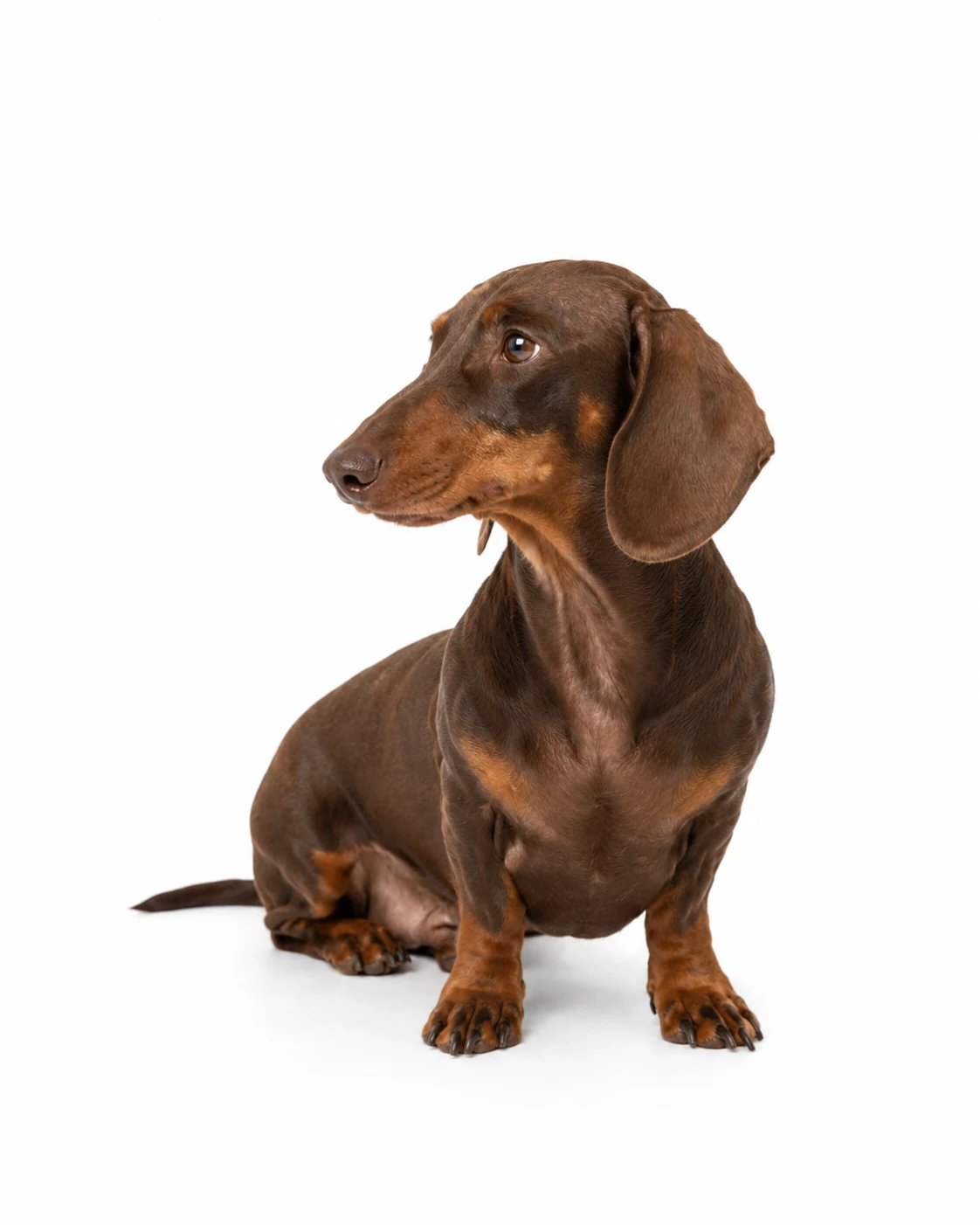
A chocolate and tan smooth haired Dachshund sitting and looking to one side

THE BREED IN BRIEF

BREED AT A GLANCE

Individual Dachshunds vary according to size, coat, breeding, health, age, socialisation, training history and personality. The figures below are useful comparison points rather than guarantees.

Size
Small to medium

Miniatures are small, Standards medium

Broad comparison scale rather than a measurement. [1]

ToyGiant
Typical adult height
20 to 27 cm

Standard. Miniature 13 to 18 cm

PDSA indicative ranges. The Royal Kennel Club breed standard specifies proportions and weight rather than a fixed height range. [2][3]

Typical adult weight
9 to 12 kg

Standard. Miniature about 4.5 kg

The Standard ideal is 9 to 12 kg. Miniature ideal is about 4.5 kg, with 5 kg the stated maximum in the breed standard. [2][3]

Typical lifespan
Over 12 years

Typical adult lifespan

Royal Kennel Club and PDSA summary guidance. An individual dog may live for a shorter or longer period. [1][3]

Adult exercise
Around 30 to 60 minutes daily as a published minimum, depending on size

PDSA gives one hour for a Standard and 30 minutes for a Miniature, normally split into walks with sniffing time. Broad comparison scale: moderate. [3]

LowHigh
Routine grooming
Weekly to several times weekly

Smooth coats are lowest maintenance. Long and Wire coats require more frequent attention, and Wire coats need periodic stripping. Broad comparison scale: low to moderate, coat dependent. [1][20]

LowHigh
Shedding
Yes, all six varieties shed

Coat texture and household impact differ by variety. Broad comparison scale: low to moderate, coat dependent. [1]

LowHigh
Trainability
Intelligent but often independent

Can learn well with reward-based, consistent training. Scent and persistence can compete with the handler. Broad comparison scale: moderate. [2][3][15]

ChallengingEasy
Time alone
Usually limited

The breed is strongly people-oriented in PDSA guidance and may struggle if alone time is introduced too quickly. Broad comparison scale: low tolerance. [3][16]

Lower toleranceHigher tolerance

Breed background

Breed group
Hound [1]
Origin
Germany [1]
Original purpose
Going to ground after badger or rabbit and tracking wounded game such as deer [1]
Coat
Smooth, Long or Wire Haired, each in Standard and Miniature size [1]

Lifestyle and character

Mental stimulation
Regular scent-based enrichment and short training sessions are important because the breed was selected to search and persist [1][2]
Vocalisation
Often noticeable. Early training and management can reduce unnecessary barking, but a completely quiet Dachshund should not be assumed [3]
First-time ownership
Possible for a well-prepared owner, but the breed may be easier for someone comfortable with independent hounds, gradual alone training and careful back management [3]
Typical character
Breed-standard language describes an intelligent, lively, courageous, faithful, versatile and good-tempered hound. These are desired traits, not promises about every dog [2]

The main at-a-glance sources are the Royal Kennel Club Breed A to Z and breed standard, supported by PDSA practical ownership guidance. [1][2][3]

OVERVIEW AND HISTORY

WHERE THE DACHSHUND CAME FROM

The Dachshund originated in Germany, where the breed is known as the Teckel, meaning badger dog. Its low build, powerful forequarters, strong jaw and excellent nose were developed for work that could include going to ground after badger or rabbit and tracking wounded game such as deer. [1][2]

This background helps explain several modern traits. A Dachshund may investigate smells intensely, persist with a task after the owner would prefer to move on, dig, chase or vocalise when excited. The breed standard calls for a functional, moderately long body with enough ground clearance for free movement and warns against exaggeration that could harm health, welfare or soundness. [2]

In the UK, the Royal Kennel Club recognises two sizes, Standard and Miniature, and three coats, Smooth, Long and Wire, producing six recognised varieties. In Germany a third size, Kaninchen, is also recognised, but it is not a separate Royal Kennel Club variety in the UK. [1]

Most UK Dachshunds now live primarily as companions, but their historical purpose still matters when assessing suitability. A small garden or flat does not remove the need for outdoor exploration, training or secure management around wildlife and interesting scents.

TEMPERAMENT AND PERSONALITY

WHAT A DACHSHUND IS REALLY LIKE TO LIVE WITH

The Royal Kennel Club breed standard describes the ideal Dachshund as intelligent, lively, courageous, faithful, versatile and good tempered. A standard describes what breeders and judges aim for. It does not establish how every individual will behave. [2]

Many Dachshunds form close attachments to their household and enjoy being involved in daily life. They can be playful, observant and expressive. PDSA also describes an independent side, particularly in training, and notes that they may prefer substantial human company. [3]

Sociability and affection: a well-socialised Dachshund may be warm and demonstrative with familiar people, but confidence with visitors varies. Some announce arrivals loudly or take time to assess a stranger. Early, positive exposure to different people and environments is more useful than relying on breed reputation.

Independence and frustration: intelligence does not necessarily mean automatic compliance. The breed's original work required initiative away from a handler, so a Dachshund may understand a cue yet decide that a scent or movement is more rewarding. Short sessions, valuable rewards and consistent rules are generally more productive than repetition or confrontation. [2][3][15]

Hunting and chase drive: Dachshunds were developed to hunt and track. The strength of chase, digging and scent-following behaviour differs between individuals, but owners should plan for these instincts rather than assuming their dog's size makes them insignificant. [1][2]

Guarding and vocalisation: the breed is not a specialist guard dog, but many Dachshunds are alert and ready to bark. A deep voice, repeated alert barking or noise triggered by people in communal areas can be a practical concern in flats. Training should include a calm response to doors, windows and outside sounds from puppyhood. [3]

Adaptability and sensitivity: many can adapt to town or country living if their exercise, scenting and companionship needs are met. [1] Busy environments should be introduced gradually. A dog that is worried, in pain or poorly socialised may behave very differently from the breed ideal, and sudden behavioural change warrants veterinary assessment.

What owners often love

  • A compact dog with a strong, distinctive personality
  • Close involvement in household routines
  • Playfulness and a sense of humour
  • Enthusiasm for sniffing, searching and food-based training
  • A choice of two sizes and three coat types
  • The ability to enjoy both purposeful walks and relaxed time at home once needs are met

What owners may underestimate

  • How persistent scent-following can make recall difficult
  • The volume and frequency of alert barking
  • The amount of gradual work needed for calm time alone
  • The importance of preventing excess weight and managing repeated jumping
  • The grooming difference between Smooth, Long and Wire coats
  • How vulnerable a long-backed dog can be to rough handling by children or larger dogs

FAMILY LIFE AND CHILDREN

DACHSHUNDS IN A FAMILY HOME

Many well-socialised Dachshunds can live successfully with children, but interactions should still be supervised. No breed can be described as automatically safe with a child. [17]

The breed is low to the ground and relatively small, yet not necessarily delicate in personality. The practical concern is the long back: a child should never lift a Dachshund without adult guidance, sit on the dog, pull the ears or tail, interrupt sleep, take food or climb over the dog. The RSPCA advises giving every dog a quiet private area and teaching children to leave the dog alone while resting, eating or using that space. [17]

Toddlers may move unpredictably, fall onto a dog or pursue it when it tries to move away. In homes with babies or toddlers, use physical separation and active supervision rather than expecting either the child or dog to manage the interaction. Primary-age children can take part in supervised reward-based training, food preparation and gentle grooming. Older children may be able to help with walks, but an adult should remain responsible for the dog's welfare and safety.

A Dachshund may become excited by running, shouting or floor-level play. Teach children to pause rather than chase the dog, and teach the dog a settle cue and a reliable route to its resting area. Pain can reduce tolerance, so a dog showing reluctance to move, sensitivity when touched or a sudden change around children should be assessed by a vet.

OTHER DOGS AND HOUSEHOLD PETS

LIVING ALONGSIDE OTHER ANIMALS

Individual history and early exposure matter more than a simple breed label.

Other dogs: many Dachshunds live with other dogs, including other Dachshunds. Their low height and long back mean that very physical play with a much larger dog may need interruption before it becomes unsafe. Controlled introductions, parallel walks and separate resting and feeding areas can reduce conflict. Do not assume that a second dog will solve distress when left alone. Each dog still needs individual separation training, one-to-one handling and the ability to rest without being disturbed.

Cats: a Dachshund raised calmly with a confident, dog-experienced cat may coexist successfully. Hunting background means chasing remains possible, particularly outdoors or when a cat runs. Introductions should use barriers, escape routes and rewards for disengagement, and unsupervised access should wait until behaviour is reliably calm.

Rabbits, rodents and other small animals: the breed's historical work included hunting rabbit and going to ground. [1] Small pets should therefore be housed in secure, dog-proof accommodation in a separate area. Familiarity does not remove prey risk, and direct contact is not recommended merely because the dog appears calm.

Resource management: feed animals separately until their behaviour around food is well understood. Provide enough beds, toys and human attention to reduce competition. Any repeated guarding, freezing, hard staring or conflict should be addressed early with a suitably qualified behaviour professional.

EXERCISE AND MENTAL STIMULATION

SHORT LEGS, SERIOUS SNIFFING NEEDS

PDSA gives a published minimum of about one hour a day for a healthy Standard Dachshund and 30 minutes for a Miniature, normally split across more than one walk and including time to sniff. [3] The Royal Kennel Club broadly lists up to one hour a day across the varieties. [1]

These figures are starting points rather than fixed prescriptions. Age, fitness, weather, body condition, health and temperament matter. A steady, inquisitive walk can be more valuable than rushing the same distance on a tight schedule.

Puppies need frequent short opportunities to explore, socialise and practise skills rather than forced distance. Avoid repetitive stair climbing, repeated leaps from furniture, high-impact fetch and exercise that continues after the puppy is tired. Growth, confidence and coordination develop at different rates, so ask the puppy's vet for individual guidance.

Older Dachshunds often benefit from continuing gentle daily movement. Reduce speed, duration or terrain rather than stopping activity altogether unless a vet advises rest. Monitor for stiffness, shortened stride, hesitation on slopes, scuffed nails, altered posture or reluctance to rise.

Recall and off-lead exercise: a Dachshund may follow a smell beyond the point at which it notices the owner. Build recall on a long line, reward heavily and avoid testing it in unsafe areas. Secure fields can provide freedom while training develops. A garden or field boundary must prevent squeezing under gaps and digging out.

Weather: the low body places the chest close to cold, wet or hot ground. Smooth-coated dogs may need additional warmth in cold conditions, while all varieties need shade, water and reduced intensity in heat. Dry Long and Wire coats thoroughly after wet or muddy walks, including the underside.

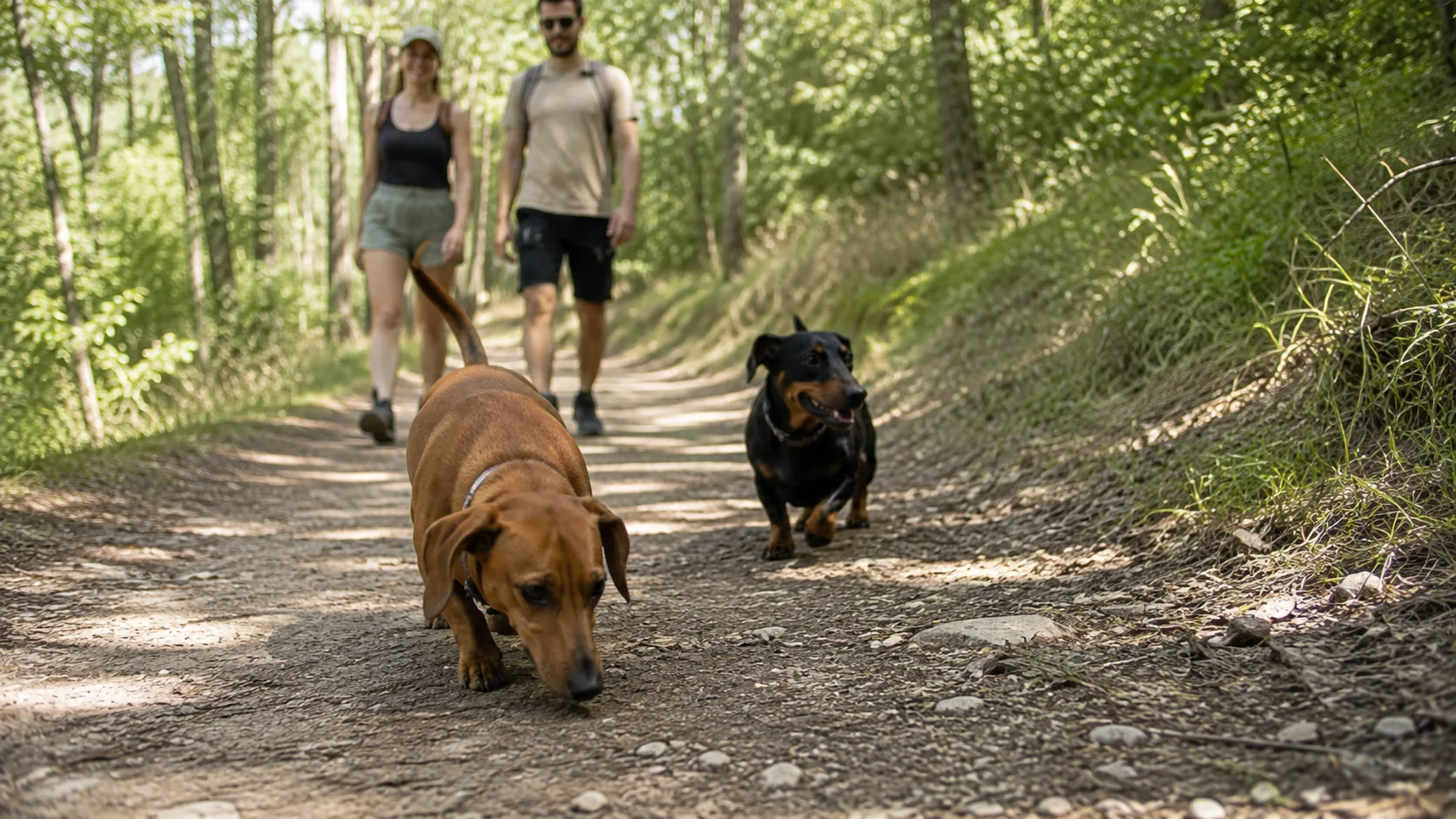
A tan Dachshund sniffing along a woodland path with a black and tan Dachshund alongside and two owners walking behind

Useful activities for adults

  • Two or more walks rather than one prolonged outing
  • Controlled sniffing and tracking games
  • Secure free movement on suitable ground
  • Short play sessions that avoid uncontrolled twisting or repeated jumping
  • Low-impact conditioning recommended by a vet or veterinary physiotherapist where appropriate

Mental stimulation

  • Food searches and scent trails
  • Cardboard-box searches and simple tracking
  • Choice-based handling practice
  • Brief training games through the day

A garden is useful for toileting and supervised play but does not replace walks, novel smells, training and exposure to the wider environment. A healthy adult might have a 20 to 30 minute morning sniff walk, a short food-search or training session at lunchtime, and another 20 to 30 minute outing later, adjusted down for a Miniature or up within the dog's healthy capability.

TRAINING AND BEHAVIOUR

INTELLIGENT, INDEPENDENT AND LED BY THE NOSE

Dachshunds can learn a wide range of skills, but intelligence and ease of training are not the same. Their independent working history means they often need a clear reason to respond. Dogs Trust describes positive reinforcement as rewarding a desired choice so that the dog is more likely to repeat it. [15]

Harsh handling, intimidation or physical correction may damage trust and can worsen defensive behaviour. Use small, valuable rewards, short sessions and management that prevents repeated rehearsal of unwanted behaviour.

During adolescence, recall may appear to deteriorate and alert barking or scent fixation may intensify. Return temporarily to a long line, reduce distractions and reinforce previously learned skills rather than assuming defiance.

Separation training: PDSA notes that Dachshunds can be strongly attached to people and may develop separation anxiety. [3] Dogs Trust recommends teaching alone time gradually and ensuring the dog can relax rather than simply endure distress. [16] Video monitoring can reveal pacing, vocalising, panting or repeated attempts to escape. Persistent distress needs professional help rather than longer absences as a test.

Common unwanted behaviours include repeated barking, digging, scavenging, pulling towards scents, unreliable recall, distress when separated and reluctance to surrender objects. These behaviours are not inevitable. Good breeding, early socialisation, pain-free health, realistic management and consistent reward-based training all influence outcome.

Training priorities

  1. 01Name response and attention, rewarding quick orientation to the handler
  2. 02Recall around scent, starting indoors and progressing to a long line
  3. 03Loose-lead walking, because a low dog can still pull strongly on a trail
  4. 04Calm handling and lifting, supporting chest and hindquarters
  5. 05Settling away from the owner while people move around the home
  6. 06Gradual time alone, built in seconds while the dog remains relaxed
  7. 07Barking management, reducing triggers and reinforcing quiet alternatives
  8. 08Leave, drop and disengage around wildlife, found food and household items

SIZE, HOME AND PRACTICAL LIVING

WHAT A LONG-BACKED DOG ASKS OF YOUR HOME

A Miniature Dachshund is small and a Standard is medium by Royal Kennel Club comparison categories. [1] Neither necessarily needs a large house. A flat can work when the dog receives suitable exercise and can cope with communal sounds, lifts, corridors and neighbours.

Stairs and furniture: a long-backed dog may face repeated daily strain from uncontrolled jumping and difficult stairs. Practical management can include stair gates, teaching the dog to wait to be lifted where safe, stable ramps with good grip and arranging beds so the dog does not need to jump from height. Support both chest and hindquarters when lifting. Any handling plan should be realistic for the owner and comfortable for the dog.

Floors and sleeping areas: slippery flooring can make controlled movement harder. Use secure runners or mats in high-traffic areas. Provide a supportive bed in a draught-free position and at least one quiet resting area away from children and household traffic.

Garden and fencing: a large garden is not essential, but a secure boundary matters. Check low gaps, gate clearance and areas where the dog could dig. Supervise near ponds, steep drops or steps.

Transport: use a secure travel crate or suitable restraint. Ramps or carefully supported lifting may make repeated car access easier. A Standard Dachshund is heavier than its height suggests, so owners with limited mobility should test whether they can safely manage transport and emergencies.

Town and rural living: town living requires early work on traffic, people, dogs, delivery noise and shared entrances. Rural living brings wildlife, livestock and powerful scent trails, so secure recall management remains important. The Royal Kennel Club lists the breed as adaptable to town or country. [1]

Household impact: expect some shedding from every variety, mud on the underside, and potentially frequent barking. Long coats can carry debris, Wire coats require stripping, and Smooth coats shed short hairs that can embed in fabrics. Drooling is not usually a defining breed issue, but individuals vary.

GROOMING, COAT AND SHEDDING

THREE COATS, THREE DIFFERENT WORKLOADS

All Dachshunds shed, but grooming differs substantially by coat. [1]

Smooth Haired: the coat is dense, short and smooth. [2] Brush or wipe through around once a week to remove loose hair and check the skin. Short hairs may still be noticeable on upholstery and clothing.

Long Haired: long coats need brushing and combing at least weekly and often several times a week, especially behind the ears, under the legs, around the tail and on the underside. Remove grass seeds and debris promptly after walks. [20]

Wire Haired: wire coats have a harsh topcoat and dense undercoat. Dachshund Health UK advises regular grooming and removal of the dead topcoat by stripping two or three times a year, and notes that clipping can soften the texture. [20] Owners who do not hand strip should use a groomer experienced with the coat.

Ears, nails and teeth: check the ears for smell, discharge, redness or persistent scratching. Keep nails short enough for comfortable movement. The 2026 VetCompass abstract found overgrown nails among the most frequently recorded conditions in its Miniature Dachshund sample, although the study population was young and the findings should not be assumed to apply identically to Standard Dachshunds. [11] Introduce dental care early. PDSA advises regular brushing with dog-safe toothpaste, ideally daily or at least several times each week, using gradual reward-based handling. [14]

Bathing and drying: bathe when necessary using a dog-appropriate product rather than on a rigid timetable. Dry the underside, feet, ears and longer feathering after wet walks. Persistent odour, itching, hair loss or inflamed skin needs veterinary advice rather than repeated bathing.

Every day or after walks

  • Check feet and underside for grit, grass seeds and mud
  • Remove tangles or debris from Long and Wire coats
  • Brush teeth where the dog has been trained to accept it

Weekly

  • Smooth: brush or grooming mitt
  • Long: thorough brush and wide-toothed comb, with extra attention behind ears and feathering
  • Wire: brush and comb the beard, legs and furnishings
  • Check ears, eyes, nails, skin and body condition

Every one to three months, and seasonally

  • Review nail length and arrange trimming if needed
  • Assess whether a Long coat needs a tidy by an experienced groomer
  • For Wire coats, arrange hand stripping two or three times a year, or another coat plan agreed with an experienced breed groomer [20]

No dog can be guaranteed not to trigger allergies. Coat type or low visible shedding does not make an individual Dachshund hypoallergenic.

FEEDING AND HEALTHY WEIGHT

BODY CONDITION MATTERS MORE THAN THE SCALES

A Dachshund's body condition matters more than a target number on the scales alone. The waist should be visible from above, the abdomen should tuck up from the side and the ribs should be easy to feel under a light covering. PDSA's body-condition guidance can help owners monitor change and seek veterinary advice before excess weight becomes established. [13]

The 2026 VetCompass conference abstract reported obesity in 12.09% of the randomly sampled Miniature Dachshunds whose 2023 primary-care records were reviewed. This is a useful recent UK signal, but it is not a completed full paper and the sample's median age was only 2.48 years. [11]

Do not rely on a breed-average weight to decide whether an individual is lean. A fit Standard may sit within a different healthy range from a Miniature, and some dogs fall between show-standard ideals. A vet can assess body condition, muscle and growth pattern.

Practical feeding principles

  • Measure meals rather than estimating by eye
  • Count training treats within the daily ration
  • Use part of the normal meal for scent games and reinforcement
  • Review portions after neutering, reduced exercise, illness or ageing
  • Prevent access to bins, dropped food and other animals' meals
  • Feed puppies a complete diet suitable for growth and monitor steady development with the vet
  • Avoid vigorous activity immediately around a large meal

RECOGNISED HEALTH CONSIDERATIONS

HEALTH THEMES DACHSHUND OWNERS SHOULD UNDERSTAND

Many Dachshunds live long and healthy lives. A recognised breed predisposition does not mean that an individual dog will develop the condition.

1. Intervertebral disc disease (IVDD)

IVDD involves degeneration of the cushioning discs between the spinal vertebrae. Disc material can bulge or rupture and compress the spinal cord, causing pain or neurological loss. Dachshund body shape and inherited disc degeneration make this a major breed-health priority. [4][5][8] A 2015 owner survey analysed 2,031 Dachshunds and recorded 310 veterinary-diagnosed IVDD cases, an overall reported prevalence of 15.7%. The Royal Kennel Club also cites a 2018 survey of 1,173 Dachshunds over three years old in which 21.1% were reported affected. These are survey estimates rather than a prediction for a puppy, and rates differed between varieties. [4][5] Signs an owner may notice include sudden or severe back or neck pain, reluctance to move, an arched posture, wobbliness, paw placement changes, urinary accidents or inability to use one or more limbs. [5] A vet may investigate with history and neurological examination, followed where appropriate by imaging and referral. Management depends on severity and may include strict rest and medication, surgery, rehabilitation and mobility support. Sudden pain, weakness or loss of movement is urgent. The Royal Kennel Club and Dachshund Health UK IVDD scheme uses spinal radiographs to grade calcifications and is listed as Good Practice for all six varieties in the current Health Standard. [5][6] Screening changes risk information, it does not guarantee that a dog or its offspring will remain free of IVDD. Owner surveys may be affected by recall and participation bias.

2. Eye disease, including progressive retinal atrophy

Progressive retinal atrophy causes gradual loss of retinal function and can lead to blindness. The current Health Standard lists the BVA, RKC and ISDS clinical Eye Scheme as Best Practice for all six Dachshund varieties, and cord1 PRA DNA testing as Best Practice for all three Miniature varieties. [6][7][10] Other eye concerns documented within breed guidance include distichiasis, in which extra eyelashes may irritate the eye, and dry-eye conditions. A clinical examination checks the eyes directly, while a cord1 DNA test checks for a specific inherited variant. One does not replace the other. [7][10] Signs include hesitation in dim light, bumping into objects, altered pupils, redness, discharge, squinting, rubbing or apparent eye pain. Investigation may involve ophthalmic examination, tear testing or other targeted tests, and inherited-disease screening may be performed by a BVA-appointed ophthalmologist. Management depends on the condition and may include monitoring, long-term medication or specialist treatment. All breeding dogs should have a current clinical eye examination, and all Miniature breeding dogs should have the cord1 PRA DNA result checked. [6][7] A clear cord1 result does not exclude other inherited or acquired eye conditions.

3. Lafora disease in Miniature Wire Haired Dachshunds

Lafora disease is an inherited form of epilepsy recognised particularly in Miniature Wire Haired Dachshunds. It is autosomal recessive, so an affected puppy inherits the relevant mutation from both parents. Clinical signs often begin from about five years of age, so an apparently healthy young breeding dog can still pass on risk. [8][9] Signs include stimulus-sensitive jerking, generalised or focal seizures, and later possible incoordination, visual change or cognitive decline. [9] Investigation involves clinical assessment and genetic testing, with other seizure causes considered by a vet. Management covers individual neurological care and reduction of identifiable triggers, and there is no implication that every seizure in a Miniature Wire is Lafora disease. The current Royal Kennel Club Health Standard lists the Lafora DNA test as Good Practice for Miniature Wire Haired breeding dogs. [6] The condition is variety specific and should not be presented as a routine risk in Smooth or Long Haired Dachshunds.

4. Idiopathic epilepsy

Idiopathic epilepsy is a possible cause of recurrent seizures. PDSA lists Dachshunds among breeds in which it is recognised, while Dachshund Health UK reports a stronger survey signal in Miniature Long Haired dogs than in the other varieties. [8][12] Signs include full-body seizures, collapse, paddling, drooling or loss of bladder control, while focal seizures may cause localised twitching or unusual brief behaviour. Dogs may be disorientated afterwards. [12] A vet usually rules out other causes through history, examination and tests, and advanced imaging may be recommended where the presentation is atypical. [12] Management depends on frequency and severity and may involve long-term medication and monitoring. There is no simple current Royal Kennel Club DNA test for general idiopathic epilepsy in Dachshunds, so breeders should disclose affected close relatives and avoid presenting a normal examination as proof that inherited risk is absent. Breed-club prevalence estimates are survey based, not every Dachshund seizure is idiopathic epilepsy, and Lafora disease must be considered separately in Miniature Wires.

5. Obesity and loss of healthy body condition

Excess body fat is a general canine health problem and is especially undesirable in a dog whose spine and short limbs already carry a distinctive mechanical load. The 2026 VetCompass abstract reported obesity in 12.09% of the reviewed Miniature Dachshund records. [11] Signs include ribs becoming difficult to feel, loss of waist, reduced stamina, difficulty grooming or rising, and steady weight gain. Investigation covers weight trend, body-condition score, muscle-condition assessment and evaluation for medical contributors. Management means an individual feeding and activity plan agreed with a vet, and abrupt calorie restriction or unsupervised supplements are inappropriate. Prevention rests on measured meals, accounting for treats, regular weigh-ins and early adjustment when exercise changes. [13] The VetCompass finding currently comes from a conference abstract and concerns Miniature Dachshunds in UK primary care during 2023, not all Dachshunds worldwide.

6. Dental disease and overgrown nails

The 2026 VetCompass abstract reported overgrown nails, periodontal disease and broader dental disease among the most commonly recorded conditions in its Miniature Dachshund sample. [11] Signs of dental disease include bad breath, visible tartar, red gums, dropping food, chewing on one side or reluctance to eat hard food. Signs of overgrown nails include clicking, altered stance, snagging, discomfort or the nail curving towards the pad. Investigation covers oral and gait examination, and a full dental assessment may require anaesthesia and dental radiography. Management and prevention include gradual tooth-brushing with dog-safe toothpaste, veterinary dental care where needed, regular nail checks and careful trimming. [14][20] These are important everyday-care findings rather than uniquely inherited Dachshund diseases, and the abstract's young Miniature population limits generalisation.

7. Colour-associated inherited risks

Dapple is an accepted Dachshund pattern when a dog carries one copy of the relevant merle variant. Mating two dapples can produce double-dapple puppies with an increased risk of impaired sight and hearing, and the Royal Kennel Club does not accept Dachshund registrations from dapple-to-dapple matings. [1] Blue and Isabella are listed as unacceptable colours in the Royal Kennel Club breed standard. [2] Dachshund Health UK reports a strong survey association between dilute colours and skin or coat disease, including colour dilution alopecia. [19] Signs of colour dilution alopecia include thinning or broken hair, patchy hair loss, scaly or inflamed skin and secondary infection. Investigation covers dermatological examination and tests to exclude parasites, allergy, endocrine disease or infection. Management is ongoing skin care tailored by a vet, and there is no routine DNA test that can guarantee a dilute dog will or will not develop alopecia. [19] Do not mate two dapples, and do not accept rare colour marketing as a substitute for health testing, temperament and functional conformation. The dilute-colour figures derive from an owner survey and may be influenced by self-selection.

The information above is general breed guidance rather than a diagnosis. Speak to a vet about symptoms or concerns affecting an individual dog.

POLICY TERMS THAT MATTER

WHAT THIS MEANS FOR PET INSURANCE

A breed predisposition does not mean your dog will develop a condition, and it does not tell you whether treatment would be covered. Cover depends on the individual policy, its exclusions and limits, when signs or symptoms first appeared, and your pet's medical history.

These are the terms worth reading closely if you are arranging or comparing cover for a Dachshund. Wording varies between providers, so check the policy documents rather than assuming any of them applies.

Pre-existing condition wording

Anything already recorded in your pet's veterinary history may be relevant to an insurer's assessment. Definitions differ between providers, so read this one first.

Hereditary and congenital wording

Inherited and congenital conditions are never automatically covered. Check whether they are included, excluded or limited.

Chronic and recurring conditions

Long term conditions are managed year after year, so check whether treatment continues at renewal and how limits apply across policy years.

Veterinary fee limit

The overall limit, and whether it resets each year, usually matters more for a large claim than any single headline feature.

Referral, diagnostics and imaging

Specialist referral, scans and investigations are sometimes capped separately from treatment.

Bilateral and related condition definitions

Where a second problem is treated as related to the first, it draws on the same limit rather than starting fresh.

Excess and percentage contribution

Some policies add a percentage contribution as a pet gets older. The age threshold and how the contribution applies vary, so check the policy terms.

For what hereditary, congenital, pre-existing, related and bilateral actually mean, see our guide to how breed affects pet insurance.

This is general information, not a personal recommendation.

BUYING OR ADOPTING

PUPPY BUYING, BREEDER HEALTH TESTS AND RESCUE

Health testing reduces avoidable risk but cannot guarantee a healthy puppy. The Royal Kennel Club advises that both sire and dam complete the tests listed for their variety and that buyers verify results rather than accepting verbal assurances. [6]

Under the current Royal Kennel Club Health Standard, all six varieties list the RKC and Dachshund Health UK IVDD Scheme as Good Practice and the BVA, RKC and ISDS Eye Scheme as Best Practice. The three Miniature varieties add a DNA test for PRA cord1 as Best Practice, and Miniature Wire Haired also lists the Lafora DNA test as Good Practice. [6]

IVDD radiographic screening grades visible calcifications associated with IVDD risk using spinal radiographs. The dog must be 24 to 48 months old at the time of the X-ray, screening is performed once and the result remains valid for life under the current scheme. It does not prove that a dog will never develop IVDD or that every puppy will be unaffected. [5]

The BVA, RKC and ISDS clinical eye examination is carried out by an appointed veterinary ophthalmologist on both parents in all six varieties, and the current Health Standard recommends an examination within 12 months before mating. It records whether specified clinical eye findings are present at that time, and does not prove that no eye condition will ever develop. [6][7]

The PRA cord1 DNA test identifies clear, carrier or genetically affected status for a specific variant in Miniature Smooth, Miniature Long and Miniature Wire breeding stock, enabling risk-managed matings. It does not prove freedom from all retinal or eye disease. [6][10]

The Lafora DNA test identifies clear, carrier or affected genetic status for an autosomal recessive mutation in Miniature Wire Haired breeding stock, and prevents carrier-to-carrier or affected-risk matings when results are used correctly. It does not prove that the dog cannot develop another cause of seizures. [6][9]

Conformation and movement: look for a dog that can move freely and is not exaggerated. The breed standard calls for sufficient ground clearance, not less than one quarter of height at the withers, and a moderately long body rather than maximal length. [2] Avoid choosing solely for an extremely low body, very short legs or unusual colour.

A rescue Dachshund may be a suitable option for a first-time or experienced owner when the individual match is right. A rescue history may be incomplete. This is not evidence that the dog is unsuitable, it means introductions and management should proceed at the dog's pace.

Breeder checklist

  • Which of the six varieties are the sire and dam?
  • Can the breeder show Royal Kennel Club-registered names and health-result records?
  • Have both parents completed IVDD screening under the recognised scheme?
  • Is each parent's clinical eye certificate current?
  • For Miniatures, what are the cord1 PRA DNA results?
  • For Miniature Wires, what are the Lafora DNA results?
  • Are either parent or their close relatives known to have IVDD, epilepsy, serious eye disease or clinically significant skin disease?
  • Is either parent dapple? Confirm that the mating is not dapple to dapple [1]
  • How has the puppy been socialised to handling, household sounds, people and short periods without constant contact?
  • Can the puppy be seen with its mother in the environment where it was raised?
  • Will the breeder take the dog back or help if the placement does not work?
  • Are coat and adult-size expectations explained honestly rather than using labels such as teacup or rare colour?

Questions for a rehoming organisation

  • Observed behaviour with adults, children, dogs, cats and small animals
  • Handling, lifting, grooming and veterinary tolerance
  • Barking triggers and response to visitors
  • Ability to settle and cope when left
  • Toileting history
  • Mobility, previous back pain and current medication
  • Diet, body condition, dental care and nail care
  • Whether the home needs stair gates, ramps or other adjustments

A responsible breeder should be willing to discuss limitations. Screening is one part of breeding decisions alongside temperament, sound movement, functional proportions and genetic diversity. [2][6][18]

LIFE STAGES

PUPPY, ADOLESCENT, ADULT AND SENIOR

Puppy

Priorities are safe socialisation, gentle handling, toileting, name response, recall foundations and learning to relax without constant physical contact. Keep exercise varied and short rather than repetitive. Prevent uncontrolled leaps and rough play. Introduce coat care, tooth brushing, nail checks and supported lifting before they become difficult.

Adolescent

Scent following, barking and independence may intensify. Continue long-line recall, reinforce attention and maintain consistent household rules. Review body condition as growth slows. Do not assume an adolescent that looks adult has mature judgement or fully developed training.

Adult

A healthy adult needs regular exercise, sniffing, brief training and predictable companionship. Maintain healthy weight and muscle, inspect nails and teeth, follow coat-specific grooming and review the home for repetitive jumping. Breeding animals require the variety-specific tests current at the time of mating. [6]

Senior

Continue comfortable daily movement and scent enrichment. Watch for altered gait, scuffing, difficulty rising, reluctance on stairs, increased sleep, sensory change, dental discomfort or weight change. Improve floor grip, provide easy-access beds and adjust grooming positions. Veterinary reviews should consider mobility, pain, teeth, heart and general age-related change rather than assuming slowing down is inevitable.

TIME COMMITMENT AND EVERYDAY OWNERSHIP

WHAT THE WEEK ACTUALLY LOOKS LIKE

A Dachshund's recurring workload is more than a short walk around the block.

Morning: toilet break, measured breakfast used partly for training, then a sniff-focused walk adjusted for size and health. Check gait and willingness to move.

Daytime: rest near household activity, a short period of calm independence, and a brief scent-search or chewing activity. A dog left for work needs an arrangement that prevents prolonged distress and meets toileting needs.

Evening: second walk or secure exercise, a few minutes of recall or settling practice, grooming or body check, then quiet time in an accessible bed.

Plan for

  • Daily walks and sniffing
  • Short training sessions
  • Gradual alone-time practice
  • Barking management
  • Coat-specific grooming
  • Dental and nail care
  • Measured feeding and body-condition monitoring
  • Cleaning mud and hair from low body areas
  • Safe transport and lifting
  • Arranging suitable care during work, illness and holidays
  • Adapting the home and routine if mobility changes

A typical week

  • Several varied walking routes rather than the same short circuit
  • One or more secure-area recall sessions
  • Thorough coat care appropriate to the variety
  • Ear, eye, nail, tooth and skin checks
  • Weight or body-condition review
  • A new scent puzzle, training goal or calm social outing
  • Cleaning bedding and checking ramps, mats, gates and fencing

Our quote service is not live yet while we onboard insurers. Book a demo to see how it will work.

Book a demo

ADVANTAGES AND CHALLENGES

THE HONEST BALANCE

Reasons people love this breed

  • Distinctive hound character in a compact body
  • Strong attachment to familiar people
  • Playful and expressive behaviour
  • Interest in scent games and problem solving
  • Adaptability to a modest home when exercise needs are met
  • Choice of Standard or Miniature size
  • Choice of three genuinely different coat types
  • Potential for a long life, with Royal Kennel Club guidance describing a typical lifespan over 12 years [1]

Challenges to consider

  • A significant breed predisposition to IVDD
  • Recall that can be overpowered by scent
  • Alert barking and noise in shared buildings
  • Possible distress when left without gradual training
  • Need to control weight and repeated jumping throughout life
  • Rough play or lifting can be particularly inappropriate for the long back
  • Long and Wire coats require more work than many buyers expect
  • Variety-specific health tests mean health tested is too vague on its own

SUITABILITY

WHO THE BREED MAY SUIT

A Dachshund may suit

  • An individual or family prepared to supervise children and teach respectful handling
  • Someone who enjoys reward-based training but does not require instant obedience
  • A household able to provide company or a carefully planned day-care routine
  • An owner interested in scent work, tracking games or structured enrichment
  • A town or rural home with secure outdoor access and suitable walks
  • A first-time owner who has researched the breed's health and behaviour and can access training support
  • An experienced hound or terrier owner comfortable with persistence and prey drive
  • Someone willing to adapt furniture, stairs and floors if needed

Another breed may be more appropriate for someone who

  • Needs a reliably quiet dog in a noise-sensitive building
  • Expects dependable off-lead recall without sustained training and management
  • Is away for long periods without suitable care
  • Wants a dog that accepts rough child play or frequent lifting
  • Cannot manage stair gates, ramps or safe transport if mobility becomes limited
  • Wants the same low grooming workload regardless of coat type
  • Is unwilling to monitor weight closely
  • Is choosing mainly for extreme body shape, very small size or a rare colour

This is a matching decision, not a judgement on the reader. Choosing a breed whose needs fit the household is responsible ownership.

ALTERNATIVES

SIMILAR BREEDS TO CONSIDER

Beagle

A Beagle shares scent-hound curiosity and may suit someone who enjoys tracking and outdoor exploration. It is taller, generally more physically robust in everyday play and still requires secure management because scent can override recall. It may suit someone who wants a larger, more pack-oriented hound rather than the Dachshund's long-backed shape. [21]

Basset Fauve de Bretagne

This small French scent hound offers a rough coat and purposeful tracking character without the Dachshund's extreme length-to-height ratio. It is generally a more athletic, longer-legged choice and may suit a household seeking a compact working hound for longer countryside outings. [22]

Border Terrier

A Border Terrier is another small, determined working dog. It is longer-legged, usually more physically suited to brisk activity and has a different terrier rather than scent-hound style. It may suit someone who likes a wiry, practical dog but is less attached to Dachshund body shape. [23]

Miniature Schnauzer

A Miniature Schnauzer is small, alert and trainable, with a coat that needs regular grooming and clipping or stripping. It may suit someone wanting a compact, vocal watchdog type that is often more handler-focused, while accepting a substantial professional-grooming commitment. [24]

Whippet

A Whippet is taller and much lighter in outline, with a smooth low-maintenance coat and a tendency to sprint rather than follow scent methodically. It may suit someone who wants a generally quieter indoor hound and can provide safe running opportunities, while still managing prey drive. [25]

COMMON QUESTIONS

DACHSHUND FAQS

A well-socialised Dachshund can live successfully in a family, but suitability depends on the individual dog and the household. Children need active supervision, respectful handling rules and a clear understanding that the dog's back should not be climbed on, pulled or roughly lifted.

EDITORIAL STANDARDS

HOW WE CHECK THIS GUIDE

This guide uses recognised UK breed, welfare and veterinary sources, including the Royal Kennel Club, British Veterinary Association, PDSA, RSPCA, Dogs Trust, Dachshund Health UK, Royal Veterinary College-linked research and VetCompass evidence. Breed tendencies do not predict every individual dog. Health information is reviewed periodically, and a material change to the Royal Kennel Club Health Standard or other official guidance should trigger an update.

Written by
Yeti Compare editorial team
Material update
Initial breed guide

This guide provides general information about the breed. Individual dogs vary, and the health information is not a diagnosis or a substitute for veterinary advice.

Sources and references

KEEP READING

OTHER BREED GUIDES

Researching more than one breed? These guides follow the same format, so you can compare temperament, health and day to day needs side by side.

ALREADY HAVE A DACHSHUND?

SEE HOW OUR QUOTE SERVICE WILL WORK

Our quote service is not live yet while we onboard insurers. Book a demo to see how it will work.