Yeti Compare

FRENCH BULLDOG BREED GUIDE

LIVING WITH A FRENCH BULLDOG: WHAT OWNERS SHOULD KNOW

Our quote service is not live yet while we onboard insurers. Book a demo to see how it will work.

French Bulldogs are compact, deeply affectionate companion dogs known for their expressive character, short coat and close attachment to people. Their modest size and moderate exercise needs can work well in smaller homes, but prospective owners often underestimate how carefully breathing, heat, weight, skin, eye and spinal health may need to be managed. [1] [2] [3] [5]

Primary takeaway: a French Bulldog may suit someone wanting a sociable, playful dog that stays close to home, provided they are prepared to prioritise health over appearance and adapt exercise, travel and daily routines around the dog's individual breathing and mobility.

A fawn French Bulldog with upright bat ears sitting and facing the camera

THE BREED IN BRIEF

THE FRENCH BULLDOG

Individual dogs vary according to breeding, health, age, early experience, socialisation, training history and personality. The breed standard describes the desired ideal; it does not predict every dog's behaviour. [2]

Size
Small

Compact but sturdy and muscular

ToyGiant
Typical adult height
Around 30 cm

Indicative adult height

PDSA publishes an indicative average. The Royal Kennel Club standard does not prescribe height. [2] [3]

Typical adult weight
11 to 12.5 kg

Females about 11 kg, males about 12.5 kg

These are Royal Kennel Club ideal weights, not guaranteed adult weights. [2]

Typical lifespan
Around 10 years

Royal Kennel Club guidance

The Royal Kennel Club says over 10 years. A large 2024 UK dataset reported a median of 9.8 years. [1] [4]

Adult exercise
Up to about one hour daily, usually split into shorter walks and adjusted for breathing, fitness and weather. [1] [3] [9]
LowHigh
Routine grooming
Weekly for the short coat, plus regular fold, ear, nail and dental care. [1] [3]
LowHigh
Shedding
Low to moderate. The breed sheds, although the short coat is usually manageable with weekly brushing. [1] [3]
LowHigh
Trainability
Moderate to good. Intelligent and responsive, but consistency and reward-based methods matter. [2] [3]
ChallengingEasy
Time alone
Short periods only. People-focused dogs may struggle with prolonged or poorly prepared separation. [3]
Lower toleranceHigher tolerance

Breed background

Breed group
Utility
Origin
Developed from small Bulldogs taken from Britain to northern France during the nineteenth century
Original purpose
Primarily a companion breed, developed from smaller Bulldog types rather than as an endurance or field-working dog
Coat
Fine, smooth, short and close

Lifestyle and character

Mental stimulation
Daily short training, sniffing and food-based enrichment are useful alongside physical exercise
Vocalisation
Often not among the most persistent barkers, but boredom, distress or learned attention-seeking can increase noise
First-time ownership
Possible for a well-researched owner, but health management and separation training make the breed less straightforward than its size suggests
Typical character
Affectionate, lively, intelligent, playful and strongly people-oriented, with individual variation

Principal sources are the Royal Kennel Club breed profile and standard, PDSA breed guidance and a 2024 UK longevity study. [1] [2] [3] [4]

ORIGINS AND MODERN ROLE

WHERE THE FRENCH BULLDOG CAME FROM

The modern French Bulldog has part of its ancestry in nineteenth-century Britain. The Royal Kennel Club describes a small Toy Bulldog type that was popular in parts of the country in the 1850s. Nottingham lace makers who moved to northern France took these dogs with them, where further development, probably including crosses with other short-faced dogs, produced a recognisable French Bulldog over the following decades. [1]

The breed became fashionable in Parisian society and returned to Britain near the end of the nineteenth century. The French Bulldog Club of England was formed in 1902, and the Kennel Club formally recognised the breed in 1906. [1]

Unlike many working breeds, the French Bulldog's modern role is predominantly companionship. Its compact build, short coat and strong attachment to people fit that role, although those same physical features should never be exaggerated at the expense of sound movement, open nostrils, comfortable breathing or welfare. The current breed standard states that balance and absolute soundness are essential and that respiratory distress or excessive respiratory noise is unacceptable. [2]

TEMPERAMENT AND PERSONALITY

WHAT IS A FRENCH BULLDOG REALLY LIKE TO LIVE WITH?

The Royal Kennel Club standard describes the breed as vivacious, deeply affectionate and intelligent. PDSA likewise characterises French Bulldogs as loving, playful and people-oriented, while noting that they can be strong-willed and sensitive. [2] [3]

In practical terms, many French Bulldogs want to be involved in whatever their household is doing. They may settle happily beside an owner after a short walk, then become animated when play or visitors begin. They are usually better understood as companion dogs with bursts of lively behaviour than as inactive lapdogs.

Their intelligence does not automatically make training effortless. A French Bulldog may learn a cue quickly but decide that the reward or situation is not worthwhile. Clear routines, short sessions and consistent consequences generally work better than repetition or confrontation. [3]

Behaviour is affected by genetics, pain, breathing comfort, early rearing, socialisation, training and individual experience. Apparent stubbornness can sometimes reflect fatigue, anxiety, distraction or physical discomfort rather than deliberate defiance.

What owners often love

  • Strong affection and desire for human company
  • Comical, expressive behaviour without needing hours of intense activity
  • A compact body that is easier to accommodate than a large dog
  • Short, manageable training sessions and playful interaction
  • A tendency to settle indoors once appropriately exercised
  • An adaptable social style in well-managed homes

What owners may underestimate

  • The amount of attention and gradual separation training a people-focused dog may require
  • The difference between ordinary snuffling and clinically significant breathing noise
  • How quickly heat, excitement or overexertion can become unsafe
  • The need to monitor skin folds, ears, eyes, teeth, weight and movement despite the short coat
  • The possibility of strong preferences, selective listening or frustration when boundaries change
  • The practical limits that breathing or spinal health can place on walks, travel and play

FAMILY LIFE AND CHILDREN

SUPERVISION MATTERS MORE THAN BREED NAME

Many well-socialised French Bulldogs can live successfully with children, but interactions should still be supervised. PDSA describes the breed as generally laid-back and adaptable around children while specifically warning that playful interaction can become boisterous. [3]

Their small height can make them seem physically robust and easy for children to handle, but French Bulldogs are muscular dogs rather than delicate toys. Toddlers may be knocked over during excited play, while a dog can be hurt or frightened by hugging, climbing, waking or rough handling.

Children should learn to leave the dog alone while it is eating, sleeping or using its quiet area. Adults should watch for avoidance, lip licking, freezing, turning away, tense posture or attempts to leave rather than expecting the dog to tolerate unwanted contact.

In homes with babies or very young children, the main challenges are often supervision, noise, interrupted rest and keeping the dog from becoming overexcited. Older children may be able to help with short training games, grooming and calm enrichment, provided an adult remains responsible.

OTHER DOGS AND HOUSEHOLD PETS

SOCIABLE, BUT INTRODUCTIONS STILL NEED MANAGING

PDSA states that well-socialised French Bulldogs can often live with other dogs, but social compatibility depends on individual temperament, play style and history. Early, controlled exposure to suitable dogs is more useful than forcing interaction with every dog encountered. [3]

Some French Bulldogs play physically and use their front paws, chest and vocalisations. This can be misunderstood by quieter dogs. Breaks, matching play partners and calm recall away from play can prevent arousal escalating.

A French Bulldog raised calmly with a cat may live successfully with that cat. PDSA also notes that some individuals may chase unfamiliar cats or smaller animals, so introductions should be gradual and management should continue until behaviour is reliably safe. [3]

Small pets such as rabbits, rodents and birds should remain securely separated. Familiarity does not remove predatory or excitable behaviour, and direct access should not be assumed safe.

EXERCISE AND MENTAL STIMULATION

A CEILING, NOT A TARGET

The Royal Kennel Club and PDSA both give a broad adult guide of up to one hour of exercise per day. PDSA recommends dividing this into shorter walks with opportunities to sniff, play and use the brain. [1] [3]

That figure is a ceiling and planning guide, not a target every dog must reach. A healthy adult with a strong respiratory function grade may comfortably do more purposeful activity than a dog with BOAS, spinal pain, obesity or advanced age. Exercise should be adapted to the individual dog's breathing, gait, recovery and weather.

French Bulldogs are at increased risk of heat-related illness. RVC research using UK veterinary data identified the breed among those at greatest risk, and PDSA advises avoiding hot parts of the day and stopping when breathing becomes laboured. [9] [18]

Avoid repetitive jumping, prolonged ball chasing, strenuous running beside a bicycle, hard exercise in heat and activities that encourage a dog to continue after breathing has become noisy or recovery slow. A harness avoids direct pressure on the neck and airway. [18]

Puppies need frequent, short opportunities to explore rather than formal endurance exercise. Protect developing joints and the spine from repeated stair climbing, jumping from furniture and uncontrolled high-impact play. Seniors may benefit from shorter, more frequent walks and non-slip indoor surfaces.

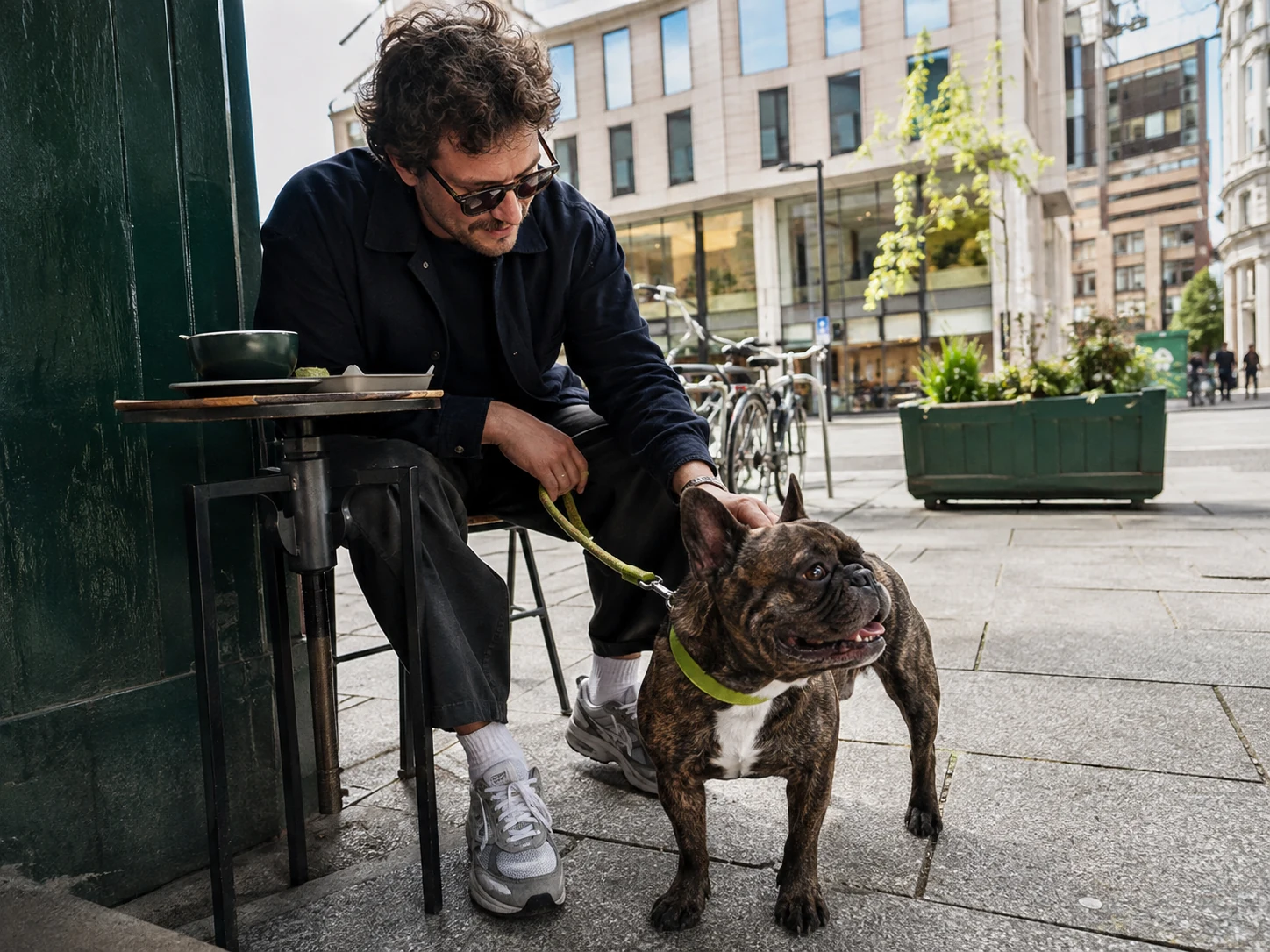
Brindle French Bulldog standing calmly beside its owner at a city cafe table.

Suitable activities

  • Two or three short walks rather than one long forced march
  • Slow sniffing walks in cool conditions
  • Short reward-based training sessions
  • Food-search games and simple scent work
  • Gentle tug or toy play with pauses
  • Controlled social walks with compatible dogs
  • Low-impact balance and body-awareness exercises where medically appropriate

A realistic day of activity

  • A 20-minute cool morning walk with sniffing
  • Five minutes of training at breakfast
  • A brief garden or indoor play session in the afternoon
  • A 20 to 25-minute evening walk
  • Calm enrichment that does not extend physical exertion

A garden is useful for toileting and short play but does not replace walks, novel smells, training and social experience.

TRAINING AND BEHAVIOUR

SHORT SESSIONS, MEANINGFUL REWARDS

French Bulldogs can learn quickly, especially when sessions are short and rewards are meaningful. PDSA recommends positive, reward-based methods and consistent household rules because the breed can be sensitive as well as strong-willed. [3]

Food can be a useful training reward, but portions should be deducted from the dog's daily allowance. Play, access to sniffing and calm praise can also be rewards. Avoid harsh corrections, physical intimidation or repeatedly drilling a cue after the dog has become tired or breathless.

Recall should be built gradually in secure spaces. A French Bulldog may be socially distracted or may chase a moving animal despite being attentive at home. Long lines and fenced areas allow practice without relying on untested off-lead reliability.

Separation should be taught from the beginning, even where someone usually works from home. Start with relaxed independence behind a gate or in another room, then increase duration slowly. Distress vocalisation, destruction, toileting or panic should not be treated as disobedience.

Training priorities

  1. 01Comfortable harness and lead walking, which protects the neck and helps owners control pace before the dog becomes overexerted
  2. 02Settle on a mat, supporting calm family life, visitors and rest between activity
  3. 03Gradual separation, reducing overdependence and helping the dog cope with ordinary absences
  4. 04Recall away from play and distractions, particularly useful around other dogs and unfamiliar cats
  5. 05Handling and cooperative care, preparing the dog for fold, ear, eye, nail, dental and veterinary checks
  6. 06Impulse control, waiting at doors, around food and before greeting
  7. 07Calm socialisation that builds confidence rather than flooding the puppy with uncontrolled contact
  8. 08Furniture and stair rules, with consistent access and use of steps or ramps to reduce repeated jumping

SIZE, HOME AND PRACTICAL LIVING

SMALL, BUT SOLIDLY BUILT

French Bulldogs are small but solidly built. The Royal Kennel Club's ideal weights are about 11 kg for females and 12.5 kg for males, although individual dogs may be lighter or heavier. [2]

A flat or modest house can work because the breed does not require a large indoor footprint. The more important questions are whether the home can remain cool, whether stairs and jumping can be managed, whether the dog has a quiet resting area and whether someone can provide regular company and short outings. [1] [3]

A private garden is helpful but not essential if toileting access is reliable. Fencing should be secure, and owners should not assume that a compact dog cannot push through gaps or follow an interesting scent. Repeated stairs may be difficult for a dog with spinal or mobility problems. In multi-storey homes, consider how the dog will reach outside if lifting becomes unsafe for the owner or uncomfortable for the dog.

French Bulldogs generally fit in ordinary cars, but travel requires more planning than size alone suggests. The vehicle must remain cool, the dog should be secured in a well-ventilated space, and breaks should be based on comfort rather than distance. Never rely on an unattended parked car remaining safe.

The breed's short coat usually means modest mud and coat maintenance, but owners should expect shed hairs, occasional drool, facial-fold cleaning and potentially audible breathing or snoring. Loud breathing should not automatically be dismissed as a normal breed trait. [7] [8]

GROOMING, COAT AND SHEDDING

A SHORT COAT WITH A REGULAR CHECKING ROUTINE

The breed standard describes a fine, smooth, lustrous, short and close coat. The Royal Kennel Club recommends weekly grooming, and PDSA says a weekly brush is generally sufficient for routine coat care. [1] [2] [3]

The short coat still sheds. A rubber grooming mitt or soft brush can lift loose hair and gives the owner a regular opportunity to check for redness, lumps, soreness or parasites.

Facial folds need particular attention. Moisture and debris can create an environment in which irritation and infection develop. Clean only as needed with an appropriate method and dry the folds thoroughly. A deep or tightly closed fold, persistent smell, redness, discharge or scratching warrants veterinary assessment. [1] [3] [5]

Check upright ears weekly for redness, excess wax, odour, discharge or discomfort. Do not insert cotton buds into the ear canal. Eye discharge, squinting, rubbing, cloudiness or sudden redness should be assessed promptly because prominent eyes and shallow sockets can increase vulnerability to injury and ulceration. [1] [5] [6]

Nails may need trimming if they do not wear naturally. Teeth should be brushed with dog-safe toothpaste as frequently as the dog will comfortably accept, ideally building towards daily care, because shortened jaws can contribute to crowding. [1]

Several times a week

  • Briefly inspect eyes, nostrils, folds and skin
  • Check that folds are dry after drinking, rain or washing
  • Brush teeth as part of a cooperative-care routine

Weekly, monthly or as needed

  • Brush the coat and check ears, paws and nails
  • Examine the tail pocket or skin around the tail where folds are present
  • Note any new odour, discharge, hair loss, redness or tenderness
  • Trim nails monthly or as needed
  • Bathe only when necessary with a dog-appropriate product
  • Review body condition and compare photographs from above and the side
  • Arrange professional or veterinary help for care the dog cannot tolerate safely

Professional coat trimming is not normally required. No dog can be guaranteed not to trigger allergies in people.

FEEDING AND HEALTHY WEIGHT

BODY CONDITION MATTERS MORE THAN A TARGET WEIGHT

French Bulldogs should receive a complete diet appropriate to age, size and health. Feeding amounts should follow the individual food's guidance and be adjusted using body condition, growth, activity and veterinary advice rather than relying on breed weight alone. [3]

PDSA notes that the breed can gain weight readily and that excess weight may make breathing and exercise more difficult. Keep treats within the daily allowance, use part of the dog's normal food for training and weigh portions rather than estimating by eye. [3] [18]

A healthy body condition is more informative than trying to force every dog towards an ideal breed-standard weight. The ribs should be easy to feel without a thick fat covering, with a visible waist from above and abdominal tuck from the side, allowing for individual conformation.

Some flat-faced dogs experience reflux, regurgitation or difficulty swallowing. Signs such as repeated gulping, coughing around meals, frequent vomiting, regurgitation, disturbed sleep or poor weight maintenance need veterinary assessment rather than a change of bowl or supplement alone. Avoid strenuous exercise immediately around meals. Slow-feeding methods may help a fast eater, but they should not delay assessment of genuine swallowing or breathing difficulty. [3]

RECOGNISED HEALTH CONSIDERATIONS

WHAT THE UK EVIDENCE SHOWS

Many French Bulldogs live enjoyable lives with their families. A recognised breed predisposition does not mean that an individual dog will develop the condition. The information below is general breed guidance rather than a diagnosis. Speak to a vet about symptoms or concerns affecting an individual dog.

A large UK VetCompass comparison of 2,781 French Bulldogs and 21,850 other dogs found that the breed had increased odds for 20 of 43 common specific disorders examined. The largest relative differences included narrowed nostrils, BOAS, ear discharge and skin-fold dermatitis. The authors cautioned that severity and duration were not fully captured and that the French Bulldog population was younger than the comparison group. [5]

BOAS and heat intolerance

Brachycephalic obstructive airway syndrome is a progressive breathing disorder linked to the anatomy of some flat-faced dogs. Excess soft tissue and narrowed structures can obstruct airflow, affecting exercise, play, eating and sleep. Owners may notice loud breathing while awake, snorting, gagging, poor exercise tolerance, prolonged recovery, disturbed sleep, collapse or a strong need to sit or sleep with the head elevated. A vet may assess nostrils, breathing at rest, response to a controlled exercise test and other airway structures. The Royal Kennel Club and University of Cambridge Respiratory Function Grading Scheme provides a standardised assessment by trained vets for dogs aged at least 12 months, repeated every two years while breeding. French Bulldogs also have increased heat-related illness risk, so exercise should be moved to cooler periods, shortened or skipped where conditions are unsafe. Relative risk does not tell an owner the exact probability for an individual dog, and respiratory grade can change with age, weight and disease progression. [7] [8] [9] [18]

Skin-fold dermatitis, allergies and other skin disease

Facial folds and any tight tail pocket can trap warmth and moisture, which can lead to redness, soreness, odour, discharge, itching and secondary infection. UK studies also identify skin as a prominent affected body region in the breed. A vet may use physical examination, skin samples, cytology, parasite tests or allergy investigations depending on the pattern. Routine care focuses on keeping folds clean and dry, maintaining healthy weight and treating underlying infection or allergy where diagnosed. Responsible breeding should avoid excessive wrinkling, very tight folds and conformational features that prevent normal ventilation or cleaning. Skin disease is a broad category with environmental, infectious, parasitic and allergic causes, so a breed association does not identify the cause in one dog. [5] [6] [10]

Ear disease

Otitis externa and ear discharge have been prominent in UK French Bulldog data. Signs can include head shaking, scratching, pain, smell, redness, discharge or reluctance to have the ears touched. A vet may examine the canal with an otoscope and take samples to identify yeast, bacteria, mites or inflammatory changes. Treatment and prevention depend on the cause, so routine use of cleaners without guidance can worsen some ears. The 2018 VetCompass population was young, and diagnostic labels in primary-care records may not fully describe underlying allergy or chronicity. [5] [6]

Eye and corneal disease

Prominent eyes and relatively shallow eye sockets can increase exposure, trauma and incomplete blinking. French Bulldogs have been associated with corneal ulceration, conjunctivitis, dry-eye problems and other ocular disorders. Warning signs include squinting, sudden redness, cloudiness, excessive tears, rubbing, discharge or keeping an eye closed, and eye pain can progress quickly. A vet may use fluorescein dye, tear testing, pressure measurement and detailed examination. Current Royal Kennel Club Best Practice recommendations include BVA, Royal Kennel Club and ISDS eye screening and a DNA test for HC-HSF4 hereditary cataracts. The clinical examination and the DNA test answer different questions, and neither guarantees lifelong normal eyes. [1] [5] [6] [10] [12] [15]

Spinal disorders and intervertebral disc disease

French Bulldogs are recognised as susceptible to spinal problems, including intervertebral disc disease and disorders associated with vertebral malformation, and the breed's health plan lists spinal disorders as a continuing priority. Signs may include back or neck pain, reluctance to jump, an arched posture, wobbliness, weakness, dragging feet, loss of coordination or sudden paralysis, and changes can be subtle or rapid. A vet may begin with neurological and orthopaedic examination, then use imaging such as radiographs, CT or MRI where needed. Owners can reduce avoidable strain by keeping the dog lean, using non-slip flooring, limiting repeated jumping and seeking assessment when movement changes. Some spinal abnormalities are visible on imaging without causing clinical disease, while some clinically important disc disease is not predictable from a routine puppy check. [6] [10] [11]

Orthopaedic conditions, including patellar luxation, hips and elbows

Patellar luxation occurs when the kneecap moves out of its normal track. A UK primary-care study cited in the breed health plan identified a possible breed predisposition, with an estimated prevalence of 4.0% in the French Bulldogs studied. Owners may notice intermittent skipping, holding up a hind leg, stiffness or reluctance to jump, while hip or elbow dysplasia can cause lameness, reduced range of movement, stiffness or altered gait. Weight management, exercise modification, pain management, rehabilitation and surgery are among the broad approaches, chosen according to the condition and individual dog. The Royal Kennel Club currently places BVA and Royal Kennel Club hip and elbow screening in Best Practice for French Bulldog breeding. A screening score is one risk indicator within a multifactorial condition influenced by genes, growth, bodyweight and environment. [1] [10] [13] [14]

Dental crowding and oral health

A shortened jaw can contain the same number of adult teeth within less space, increasing crowding and making plaque control more difficult. Signs include bad breath, visible tartar, red gums, difficulty chewing, dropping food or pawing at the mouth. A vet may examine the mouth and use dental radiographs under anaesthesia when disease is suspected. Daily tooth brushing with dog-safe toothpaste is the most practical home measure. Breeding for a more functional muzzle and jaw may reduce extremes, but there is no single DNA or screening result that rules out dental disease, which is also affected by age, individual anatomy, home care and diet. [1]

Digestive, swallowing and regurgitation problems

PDSA notes that flat-faced breeds can experience reflux or difficulty swallowing, and gastrointestinal problems have appeared in breed research and clinical reports. Repeated regurgitation, vomiting, coughing after eating, gulping, appetite change, bloating or poor weight maintenance should be investigated. A vet may assess the mouth, airway and gastrointestinal tract using examination, blood tests, imaging or referral procedures depending on signs. Management is diagnosis-specific and may involve meal pattern, bodyweight, airway management or medical treatment. Owners should not assume that frequent regurgitation is a normal French Bulldog habit, and gastrointestinal signs have many possible causes. [3] [6] [10]

Odds and prevalence figures describe populations under veterinary care and are not probabilities that an individual dog will be affected.


POLICY TERMS THAT MATTER

WHAT THIS MEANS FOR PET INSURANCE

A breed predisposition does not mean your dog will develop a condition, and it does not tell you whether treatment would be covered. Cover depends on the individual policy, its exclusions and limits, when signs or symptoms first appeared, and your pet's medical history.

These are the terms worth reading closely if you are arranging or comparing cover for a French Bulldog. Wording varies between providers, so check the policy documents rather than assuming any of them applies.

Pre-existing condition wording

Anything already recorded in your pet's veterinary history may be relevant to an insurer's assessment. Definitions differ between providers, so read this one first.

Hereditary and congenital wording

Inherited and congenital conditions are never automatically covered. Check whether they are included, excluded or limited.

Chronic and recurring conditions

Long term conditions are managed year after year, so check whether treatment continues at renewal and how limits apply across policy years.

Veterinary fee limit

The overall limit, and whether it resets each year, usually matters more for a large claim than any single headline feature.

Referral, diagnostics and imaging

Specialist referral, scans and investigations are sometimes capped separately from treatment.

Bilateral and related condition definitions

Where a second problem is treated as related to the first, it draws on the same limit rather than starting fresh.

Excess and percentage contribution

Some policies add a percentage contribution as a pet gets older. The age threshold and how the contribution applies vary, so check the policy terms.

For what hereditary, congenital, pre-existing, related and bilateral actually mean, see our guide to how breed affects pet insurance.

This is general information, not a personal recommendation.

BUYING OR ADOPTING

BREEDER HEALTH TESTING AND RESCUE

The current Royal Kennel Club Health Standard lists respiratory testing through the Royal Kennel Club and University of Cambridge Respiratory Function Grading Scheme as Good Practice for French Bulldogs. Best Practice adds HC-HSF4 hereditary-cataract DNA testing, BVA and Royal Kennel Club elbow screening, BVA, Royal Kennel Club and ISDS eye screening and BVA and Royal Kennel Club hip screening. [1]

The Respiratory Function Grading Scheme is a standardised clinical functional assessment by an approved veterinary assessor. It grades evidence of BOAS before and after a controlled exercise component, applies to both breeding dogs from 12 months old and is repeated every two years while they are used for breeding. It shows the dog's functional respiratory grade at the time of assessment and supports lower-risk mating decisions, but it cannot guarantee that every puppy will be BOAS-free or that the parent's grade will never change. [7]

The HC-HSF4 DNA test identifies a recognised autosomal-recessive HSF4 mutation and shows whether a dog is clear, a carrier or genetically affected for that particular mutation. It does not rule out other cataracts, corneal ulcers or unrelated eye disease. The BVA, Royal Kennel Club and ISDS Eye Scheme is a clinical examination by an appointed ophthalmologist that identifies observable inherited or suspected inherited eye abnormalities at the time of examination, and it does not replace the DNA test. [1] [12] [15]

The BVA and Royal Kennel Club hip and elbow schemes are standardised radiographic assessments of the prospective parents. Hip scoring shows the degree of radiographic change in each hip, and elbow grading shows evidence and grade of elbow dysplasia. Neither guarantees that offspring will have normal joints or predicts every future mobility problem. [13] [14]

Health testing reduces avoidable risk and improves the quality of breeding decisions, but it cannot guarantee a healthy puppy. The French Bulldog Club of England advises buyers to request health-scheme documentation and never buy without seeing the puppy with its mother. [16]

Practical breeder checklist

  • See the puppy interacting with its mother in the place where it was bred; do not accept a handover elsewhere
  • Ask for the registered names and microchip details of both parents so results can be checked independently
  • Verify current respiratory function grading results for both parents rather than accepting a claim that they breathe well
  • Ask for documentary evidence of all Good Practice and Best Practice tests, not only a commercial multi-gene panel
  • Observe the mother at rest and after ordinary movement, because persistent noise, distress, pinched nostrils or poor recovery are reasons to stop
  • Prioritise open nostrils, visible muzzle, sound movement and moderate conformation over fashionable colour or exaggerated features
  • Ask about spinal disease, allergies, chronic ear disease, eye ulcers, airway surgery and longevity in close relatives
  • Expect the breeder to ask detailed questions about your home, working pattern and plans for the dog

Rescue considerations

  • Ask for veterinary records, current medication and respiratory observations
  • Ask about mobility history, known triggers and time-left-alone behaviour
  • Ask for compatibility assessments with children, dogs and cats
  • Arrange a calm transition and maintain familiar food initially
  • Book a routine veterinary review after adoption
  • Expect a rescue to describe known health or behavioural needs honestly rather than relying on breed stereotypes

Sources for this section: Royal Kennel Club Health Standard and screening schemes, the French Bulldog Club of England and RSPCA puppy-buying guidance. [1] [7] [12] [13] [14] [15] [16] [17]

LIFE STAGES

WHAT CHANGES AS A FRENCH BULLDOG GROWS UP

Puppy

Puppies need short, positive social experiences, careful toilet training and early cooperative handling. Avoid repeatedly carrying the puppy into overwhelming settings in the name of socialisation. Build calm confidence around household sounds, visitors, traffic, grooming and suitable dogs. Exercise should consist mainly of free movement, gentle exploration and short walks appropriate to vaccination status and development. Limit repeated jumping from sofas, uncontrolled stairs and exhausting play, and begin alone-time practice before the puppy becomes accustomed to constant company.

Adolescent

Adolescence can bring selective listening, stronger social interest and boundary testing. Continue recall, lead walking, settling and calm greetings rather than assuming early puppy training is complete. Watch bodyweight closely after growth slows. Increasing exercise to solve every behaviour problem may be unsafe if respiratory function is poor, so use scent work, training and structured rest as well as walking.

Adult

A healthy adult usually benefits from several short activities across the day, regular fold and ear checks, dental care and ongoing weight monitoring. Reassess what is normal for the individual dog: new snoring, slower recovery, reduced jumping or reluctance to walk may be health changes rather than ageing or laziness.

Senior

Older French Bulldogs may need shorter, more frequent walks, warmer bedding, non-slip flooring and help avoiding stairs or jumps. Maintain gentle mental stimulation and review weight as activity changes. Changes in sleep, breathing, continence, vision, hearing, movement or sociability deserve assessment, and discomfort should not be assumed inevitable in an older dog.

A REALISTIC ROUTINE

WHAT OWNERSHIP LOOKS LIKE DAY TO DAY

The breed's short coat and compact size can make ownership look low-maintenance, but the recurring work is broader than brushing. Most owners need to provide company, several short activity periods, training, food management, fold and ear checks, dental care, cleaning, temperature control and observation of breathing and movement.

A French Bulldog is not a strong choice for a household routinely empty for a full working day unless reliable care is arranged. Holidays and boarding also require planning because not every carer understands brachycephalic breathing, heat limits or medication.

A typical day

  • Morning toilet break and breathing check
  • Cool 15 to 25-minute sniffing walk, adapted to weather and fitness
  • Measured breakfast, with a portion reserved for training
  • Rest near household activity, plus a brief period of independent relaxation
  • Short play, food search or training session later in the day
  • Second short walk in cool conditions
  • Fold, eye and ear check while the dog is calm
  • Tooth brushing and settled evening routine

A typical week

  • Several varied local walking routes rather than repeated strenuous exercise
  • One or two controlled social opportunities with compatible dogs
  • Weekly coat brushing and fuller skin, ear, paw and nail inspection
  • Review of body condition and any change in breathing or recovery
  • Short car or handling practice where useful
  • Planned periods alone at a duration the dog can manage calmly
  • Cleaning bedding, harnesses and any damp skin-contact areas

Our quote service is not live yet while we onboard insurers. Book a demo to see how it will work.

Book a demo

THE HONEST BALANCE

REASONS PEOPLE LOVE THIS BREED

  • Affectionate and strongly engaged with family life
  • Compact enough for many flats and smaller homes
  • Moderate exercise requirement compared with high-endurance breeds
  • Short coat with no routine clipping requirement
  • Expressive, playful and often entertaining character
  • Usually happy to combine short activities with indoor rest
  • Can respond well to concise reward-based training
  • A manageable physical size for travel and handling while healthy

THE HONEST BALANCE

CHALLENGES TO CONSIDER

  • Material risk of breathing and heat-related problems
  • Shorter median lifespan than many similarly sized breeds in current UK data [4]
  • Potential skin, ear, eye, spinal, dental and gastrointestinal needs
  • Difficulty coping with long or sudden periods alone
  • Need to distinguish genuine physical limitation from apparent stubbornness
  • Exercise and travel plans may need to change at short notice because of weather
  • Repeated cleaning and monitoring despite the low-maintenance-looking coat
  • Popularity can make poorly bred, exaggerated or irresponsibly marketed puppies easier to encounter

SUITABILITY

WHO THE BREED MAY SUIT

A French Bulldog may suit

  • An owner who wants a close companion rather than an endurance partner
  • A household able to provide company and gradual separation training
  • People living in a flat or smaller home with reliable outdoor access
  • Families prepared to supervise children and teach respectful interaction
  • Owners who enjoy short training, play and enrichment sessions
  • Someone willing to prioritise respiratory function, sound movement and verified health results over colour or extreme appearance
  • A home able to remain cool and adapt walks during warm weather
  • First-time owners who are prepared for substantial breed-specific research and management

Another breed may be more appropriate if you want

  • A dog for long-distance running, hiking in warm conditions or sustained high-intensity sport
  • A dog that can routinely be left for a full working day
  • Minimal veterinary monitoring or no daily conformation-related care
  • Reliable tolerance of heat and strenuous travel
  • A naturally independent dog
  • A breed where appearance carries fewer known welfare trade-offs
  • A dog expected to manage frequent stairs or jumping throughout life
  • A puppy chosen primarily for rare colour, very flat face or exaggerated compactness

ALTERNATIVES

SIMILAR BREEDS TO CONSIDER

These are comparison starting points rather than direct substitutes. Each breed has its own health, temperament and care requirements.

Boston Terrier

Shares a compact, short-coated companion style and lively expression. It may appeal to someone drawn to the French Bulldog's sociability but wanting to compare a lighter, more athletic outline. Boston Terriers are also brachycephalic, so respiratory health still requires careful investigation. [19]

Pug

Another small, affectionate companion with moderate exercise and grooming needs. The Pug is generally lighter and belongs to the Toy group, but it shares significant flat-faced health considerations and is not a way to avoid BOAS risk. [20]

Read the Pug guide

Staffordshire Bull Terrier

A compact, short-coated and affectionate breed with an exercise guide similar to the French Bulldog. It is physically more athletic and terrier-like, with a longer Royal Kennel Club lifespan guide, but requires confident training and careful matching to the household. [21]

Read the Staffordshire Bull Terrier guide

Border Terrier

A small, adaptable dog for people who like compact size but want a less brachycephalic working-terrier build. Border Terriers usually bring more terrier drive, outdoor energy and coat maintenance, so they suit a different daily rhythm. [22]

Adult rescue crossbreed

An adult dog from a reputable rescue may suit someone whose priority is a known size, observed temperament and household match rather than a specific pedigree appearance. Health and behaviour still require individual assessment.

COMMON QUESTIONS

FRENCH BULLDOG FAQS

A well-socialised French Bulldog can fit family life well where adults provide supervision, consistent training, a quiet resting area and realistic health management. Suitability depends on the individual dog and household rather than breed name alone.

EDITORIAL STANDARDS

HOW WE CHECK THIS GUIDE

This guide was developed using recognised UK breed, welfare and veterinary sources, including the Royal Kennel Club, Royal Veterinary College VetCompass, University of Cambridge, PDSA, RSPCA and the French Bulldog Club of England. Breed tendencies do not predict every individual dog. Material health guidance is reviewed against current official testing recommendations and relevant veterinary research, with a new review triggered if the Royal Kennel Club Health Standard or Respiratory Function Grading Scheme changes. The guide is intended to help readers make informed ownership decisions rather than to diagnose an individual dog.

Written by
Yeti Compare editorial team
Last updated
3 August 2026
Material update
Initial breed guide

This guide provides general information about the breed. Individual dogs vary, and the health information is not a diagnosis or a substitute for veterinary advice.

Sources and references

KEEP READING

OTHER BREED GUIDES

Researching more than one breed? These guides follow the same format, so you can compare temperament, health and day to day needs side by side.

ALREADY HAVE A FRENCH BULLDOG?

SEE HOW OUR QUOTE SERVICE WILL WORK

Our quote service is not live yet while we onboard insurers. Book a demo to see how it will work.